
AI SEO Strategy isn’t just about ranking blue links anymore. People increasingly get the answers they’re looking for without ever clicking a traditional result. Search engines now surface AI-generated summaries and visuals that answer questions instantly, and recommendation feeds deliver content where people actually scroll and explore.
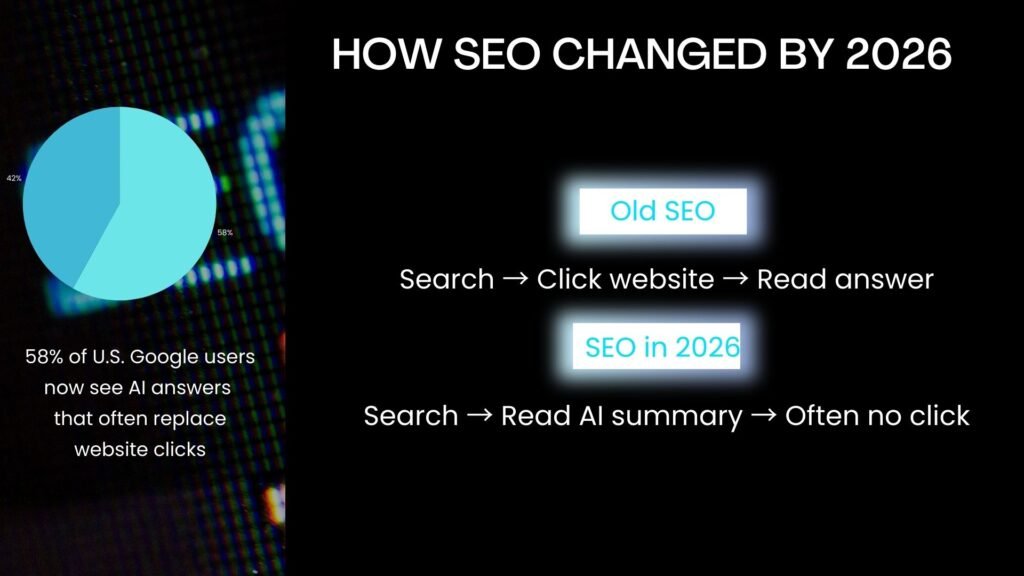
This shift picked up steam in 2025. A Pew Research Center study found that in March 2025, about six in ten U.S. searchers encountered at least one AI-generated summary in their Google results pages, and users were noticeably less likely to click on traditional links when those summaries appeared.
For creators, this means the old playbook of chasing rankings isn’t enough. To be seen now, content must be easy for AI systems to understand and quote, and also compelling enough to be saved, shared, and rediscovered on visual discovery platforms like Pinterest.
What an AI SEO Strategy Really Means in 2026
Clear question → clear answer → AI selects source → user reads summary → discovery continues elsewhere
That’s the new flow: Instead of writing to rank, creators now write so their content can be understood, summarized, and trusted by AI systems on Google, and saved and resurfaced on visual platforms like Pinterest.
| Old SEO | AI SEO in 2026 |
| Keyword targeting → ranking first → user clicks → traffic | Topic clarity → structured answers → AI citation → brand visibility (with or without clicks) |
Google’s AI summaries reward content that explains ideas cleanly and directly. Pinterest rewards ideas that are clear enough to save and return to later. A modern AI SEO strategy designs content for both outcomes at the same time.
This is why speed and volume matter less now. Structure, clarity, and intent matter more. When AI Overviews appear, clicks often fall. Ahrefs reported roughly a 34.5% drop in organic CTR when AI summaries are present, and Search Engine Land summarized similar findings across multiple studies. Visibility alone no longer guarantees traffic.
| Success is measured differently |
| Source selection → repeated exposure → long-term discovery |
If your page is cited in an AI summary, appears across related questions, or continues surfacing through Pinterest saves months later, the strategy is working — even if clicks are lower than they used to be.
That’s what an AI SEO strategy really means in 2026. It’s not about beating algorithms. It’s about designing content that survives fewer clicks and still gets chosen.
Can You Really Do SEO With AI?
AI is extremely good at speeding up the parts of SEO that slow creators down. It helps surface what people are already asking, identify whether a search is informational or commercial, and organize content into clear structures with headings, summaries, and FAQs. It also makes it easier to repurpose ideas into formats that work across platforms, such as Pinterest pins, carousels, or short scripts.
Where AI stops is just as important as where it helps. AI does not replace real experience. It does not create a consistent brand voice. It does not verify sources. And it does not earn trust. In fact, trust matters more now than it ever did before.
The strategy of 2026 shifts. Fewer clicks → higher expectations → stronger focus on credibility
If people are clicking less, your content must be strong enough to be quoted, clear enough to be summarized accurately, and trustworthy enough to be referenced. AI can help you move faster, but only human judgment makes content worth choosing. That’s how AI fits into SEO in 2026 as a powerful assistant, not the decision-maker.
How Google Discovery Changed After 2025
The biggest change after 2025 wasn’t AI summaries. It was where the decision happened.
Earlier, the decision happened after a click. Now, the decision happens before a click.
By the time someone reaches your website, Google has already decided whether your content is worth showing, summarizing, or ignoring. That means discovery no longer starts on your page. It starts inside Google’s own interface..
After 2025, discovery became less about traffic and more about eligibility.
Eligibility to be summarized.
Eligibility to be cited.
Eligibility to be reused across related questions.
If your content isn’t clear enough to be understood quickly, structured enough to be extracted cleanly, or trustworthy enough to stand on its own, it simply doesn’t enter the conversation.
Why Pinterest Is Now a Search Engine, Not Social Media
Pinterest doesn’t compete with Instagram or TikTok but it replaces Google for certain behaviors.
People don’t open Pinterest to see what’s new. They open it to find something they need later. That single difference changes everything. On social media, attention is temporary. On Pinterest, intent is stored.
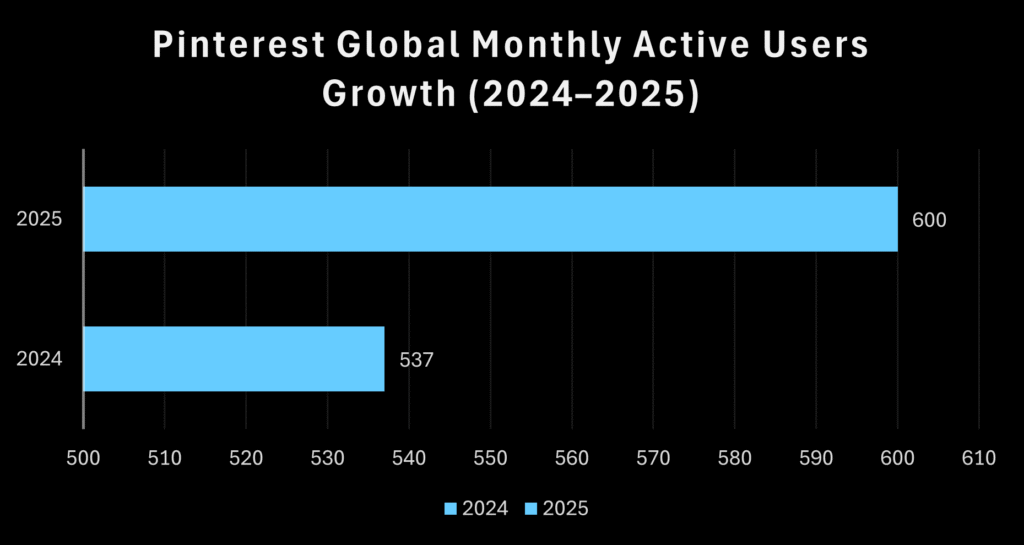
A saved pin is not engagement. It’s a bookmark for future action. This is why Pinterest continues to grow, while many social platforms struggle with userretention. Pinterest’s user base continued to grow throughout 2025. The platform reported 578 million global monthly active users in Q2 2025, and later reached an all-time high of 600 million MAUs in Q3 2025, according to its investor results. That growth didn’t come from viral trends or influencer feeds. It came from people using Pinterest as a search and planning tool.
The second shift is even more important.Pinterest is not just big it’s global
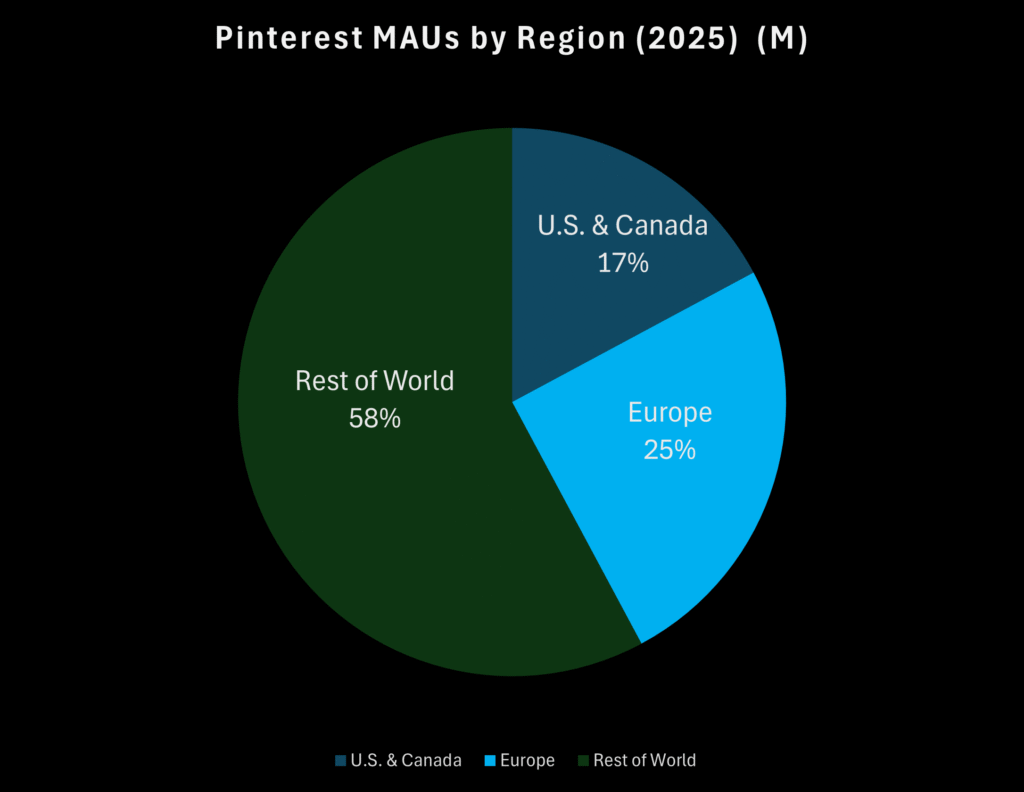
A large share of its users come from outside the U.S., which explains why visual search works so well on the platform. Images travel across languages. Planning behavior looks the same whether someone is in North America, Europe, or elsewhere. That’s why Pinterest discovery scales internationally in a way text-heavy platforms often can’t.
Google decides which explanation to trust.
Pinterest decides which idea is worth saving.
In a 2026 strategy, you don’t choose one. You use both. Google builds credibility. Pinterest compounds visibility over time.
A Practical AI SEO Strategy for Google and Pinterest
1. Clear topic → structured explanation
Write content so machines can extract meaning, not just so humans can read smoothly. Clear headings, short definitions, and direct explanations immediately after each heading make it easier for Google’s AI to understand and reuse your content. FAQ-style sections still matter because they reflect how people actually ask questions and how AI looks for reusable answers.
2. Single theme → connected content cluster
Instead of publishing scattered posts, build depth around one idea. Several interlinked articles explaining different angles of the same topic signal topical authority. In 2026, a small, well-connected cluster often performs better than frequent but unrelated publishing.
3. Discovery questions → direct answers
Optimize for discovery intent, not just keywords. Questions starting with “what,” “how,” and “why” are more likely to trigger AI summaries. Content that answers these clearly and supports claims with references carries more weight than content optimized only for placement.
4. Credible sources → trust before the click
As clicks decline, credibility must work earlier. Summarizing two to four reliable sources in your own words increases the chance that your content is cited or referenced by AI systems. Proof is no longer an add-on; it’s a requirement for selection.
5. Same topic → visual reinterpretation
Treat Pinterest as a search engine built on saving, not clicking. Turn the same topic into visual ideas with clear keywords and strong visuals. A pin’s value is measured by whether it’s saved, because saves allow content to resurface long after publication.
6. One keyword → multiple visual angles
Start with a single keyword theme and expand visually. Create multiple pins from the same content, each framed slightly differently. Consistent titles and naming help Pinterest understand relevance, while repeated saves allow reach to compound.
7. Emerging trends → early publishing
Use trend signals to publish before demand peaks. Pinterest Predicts highlights what people will search next, not what already worked. Early, well-positioned content gains visibility before competition increases.
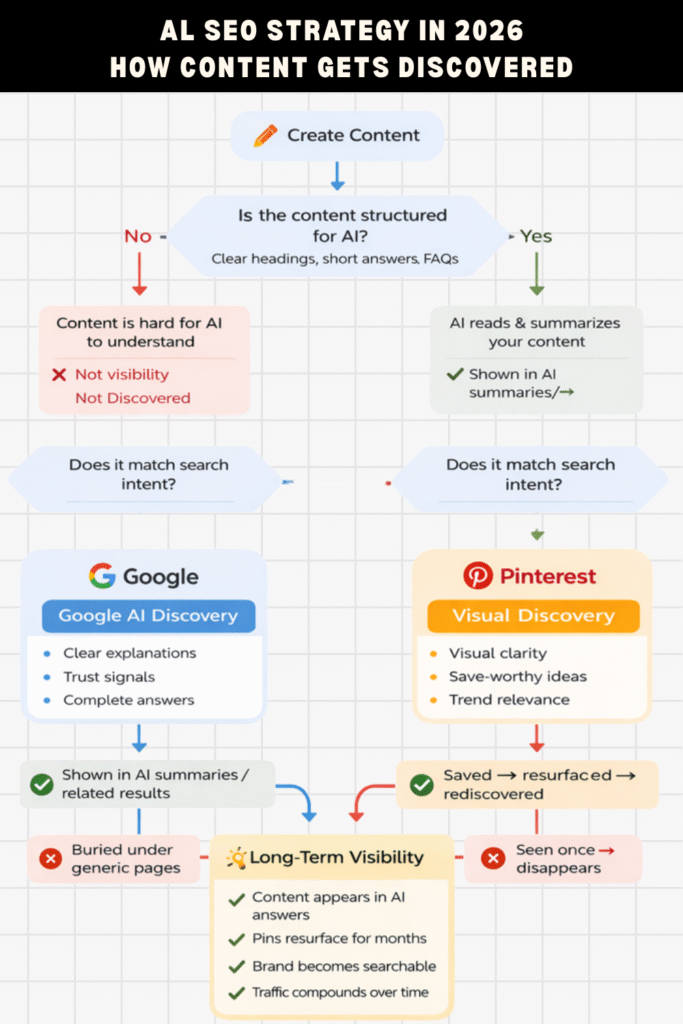
8. Google selects → Pinterest sustains
Design content to work across both systems at once. Google selects explanations it trusts. Pinterest sustains ideas people save. One builds credibility. The other extends discovery over time.
The 3 Pillars of AI SEO Strategy for Creators
Every effective strategy rests on three foundations.
1. The first is intent. Understanding what the reader wants in that moment determines whether content feels useful or forgettable.
2. The second is structure. Content must be easy to extract, with clear headings, concise explanations, internal links, and summaries that reinforce understanding.
3. The third is distribution. A single strong blog post should not live in isolation. It should generate Pinterest pins, a LinkedIn post, and short-form adaptations that extend its reach.
This is where smaller creators gain an advantage. They win not by outspending larger sites, but by reusing ideas intelligently.
Frequently Asked Questions
What is an AI SEO strategy?
An AI SEO strategy is a way of designing content so it can be clearly understood, summarized, and surfaced by AI-influenced search systems, especially on Google. At the same time, it ensures the content performs well on visual discovery platforms like Pinterest, where saves and long-term visibility matter more than immediate clicks.
In 2026, SEO is no longer just about rankings. It is about becoming a reliable source that AI systems can reference and users can recognize.
Can you really do SEO using AI tools?
Yes, but AI works best as an assistant, not as a replacement for human judgment.
AI tools are extremely useful for discovering topics, organizing content, identifying search intent, and repurposing ideas across platforms. However, decisions about accuracy, tone, experience, and trust still require human input. In fact, these human elements matter more now because AI summaries reduce clicks and increase competition for attention.
The creators who benefit most from AI are those who use it to enhance clarity, not to automate originality.
Are AI summaries reducing website traffic?
Multiple studies from 2025 suggest that clicks often decline when AI summaries or AI Overviews appear in search results.
Pew Research found that users are less likely to click when an AI-generated summary is shown. Ahrefs observed an average click-through-rate reduction of roughly 34.5 percent when AI Overviews appeared across a large keyword sample. These effects are most noticeable for non-branded informational queries.
This does not mean SEO is dead. It means the definition of success has changed.
Why should Pinterest be part of an AI SEO strategy?
Pinterest functions as a search engine built around saving and future intent, not real-time engagement, unlike traditional social platforms, Pinterest content can resurface months after publication. With hundreds of millions of monthly active users and consistent growth reported in 2025, Pinterest offers creators long-term discovery that complements Google’s increasingly answer-first behavior.
In a 2026 strategy, Google builds credibility while Pinterest sustains visibility.
How many Pinterest pins should I create for each blog post?
A practical and sustainable starting point is three to five pins per blog post.
Each pin should approach the same content from a slightly different angle, such as a how-to explanation, a checklist-style idea, a mistake to avoid, or a quick insight. Over time, saves allow these pins to compound reach, even if clicks are modest at first.
Consistency matters more than volume.
What metrics should I track to know if this strategy is working?
On Google, impressions are often more revealing than clicks in an AI-driven environment. They indicate whether your content is being surfaced and considered.
On Pinterest, saves are the most important signal. Saves show that users find your content valuable enough to return to later, which increases long-term discovery.
Together, these metrics provide a clearer picture of visibility than traffic alone.
Conclusion: What AI SEO Rewards in 2026
AI SEO in 2026 does not reward shortcuts or volume for its own sake. It rewards clarity, structure, credibility, and consistency. It rewards creators who understand that discovery now happens across systems, not just search results.
Clicks may be fewer, but influence can be greater. Creators who adapt to this reality build recognition that lasts beyond rankings. They become the sources that AI systems reference and the ideas users save for later.
That is how creators get discovered in 2026, even when SEO is no longer about ranking alone.
