
US TikTok uncertainty 2026 is already reshaping how digital creators think about reach, sales, and brand deals. If you depend on TikTok for visibility or income, it can feel like you’re building on moving ground and you’re not imagining it.
In late January 2026, TikTok’s U.S. situation entered a new phase: reporting confirms ByteDance finalized a majority American-owned joint venture (“TikTok USDS Joint Venture LLC”) to avoid a U.S. ban, with Oracle, Silver Lake, and MGX each taking stakes and ByteDance keeping a minority interest.
At nearly the same moment, U.S. users experienced outages and service issues tied to an Oracle data center incident, an example of how operational dependence can translate into creator anxiety fast.
Here’s the key: the biggest risk isn’t “TikTok disappears tomorrow.”
The risk is that creators keep behaving like TikTok is a permanent home.
What’s actually happening with TikTok in the U.S. in 2026?
1) The legal backdrop is real (and it already set deadlines)
The U.S. passed legislation that restricts the distribution/hosting of “foreign adversary-controlled applications” unless a divestment occurs. The text is on Congress.gov.
The enforcement timeline has also been addressed through executive action and public statements about delaying enforcement.
2) The “TikTok USDS” structure is meant to reduce national-security concerns
Multiple outlets describe the new structure: U.S. data protections, governance changes, and Oracle’s role in hosting U.S. user data.
3) User scale makes this huge for creators
TikTok itself stated in 2024 that the law would “silence 170 million Americans” and harm 7 million businesses, a number TikTok has used publicly.
DataReportal’s 2025 U.S. digital report (based on TikTok ad audience resources) indicates ~136M U.S. users aged 18+ in early 2025.
Reuters, in January 2026 coverage, described TikTok as being used by “over 200 million Americans.”
Creator reality: Even if TikTok “stays,” the rules of the game can change under your feet, ownership, audits, operations, moderation, and recommendation systems.
What History Shows When Platforms Change or Vanish Lessons for US TikTok Uncertainty 2026
Creators don’t lose because they’re untalented.
They lose because they’re platform-dependent.
Story 1: Vine (the platform died; the format survived)
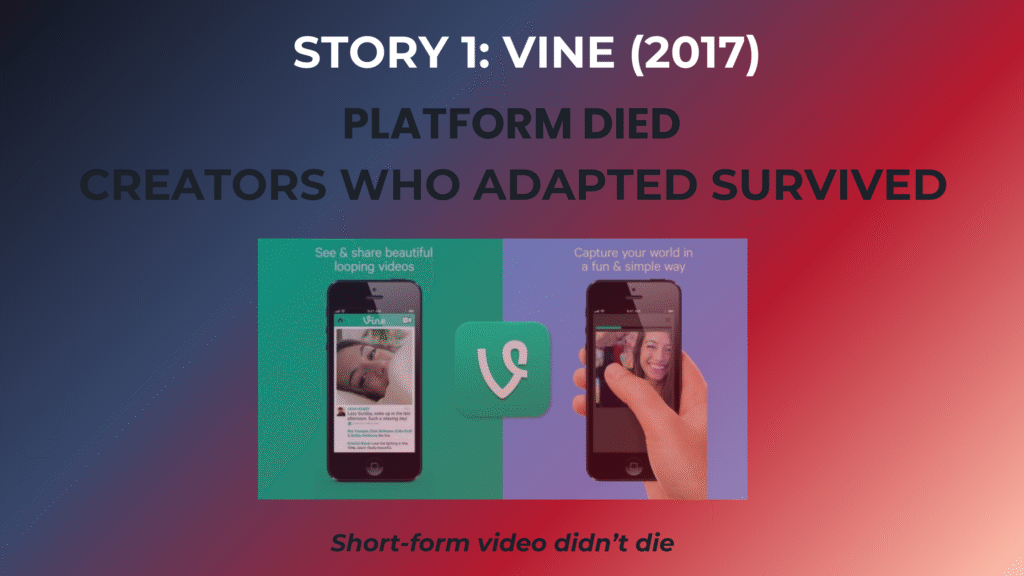
Twitter announced Vine’s shutdown in 2016 and the service effectively ended in early 2017.
Vine creators who lasted didn’t “wait for Vine.” They moved their format (short, punchy, repeatable videos) to YouTube and Instagram and built bigger careers.
Lesson: a platform can disappear; a content skillset doesn’t.
Story 2: Periscope (the feature lived on; creators still lost momentum)
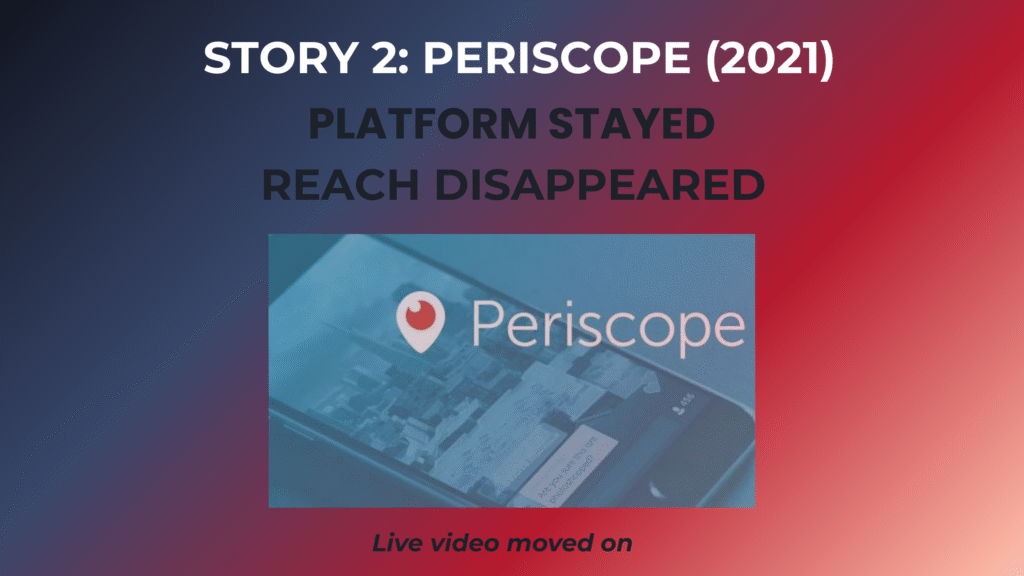
Twitter announced Periscope would be discontinued as a standalone app, and Periscope published its own “Farewell” note.
Live video didn’t end—but the distribution changed. Many creators lost their “home base” and never recovered the same reach.
Lesson: sometimes the platform doesn’t vanish—your reach does.
Story 3: Facebook reach drop (the silent killer)
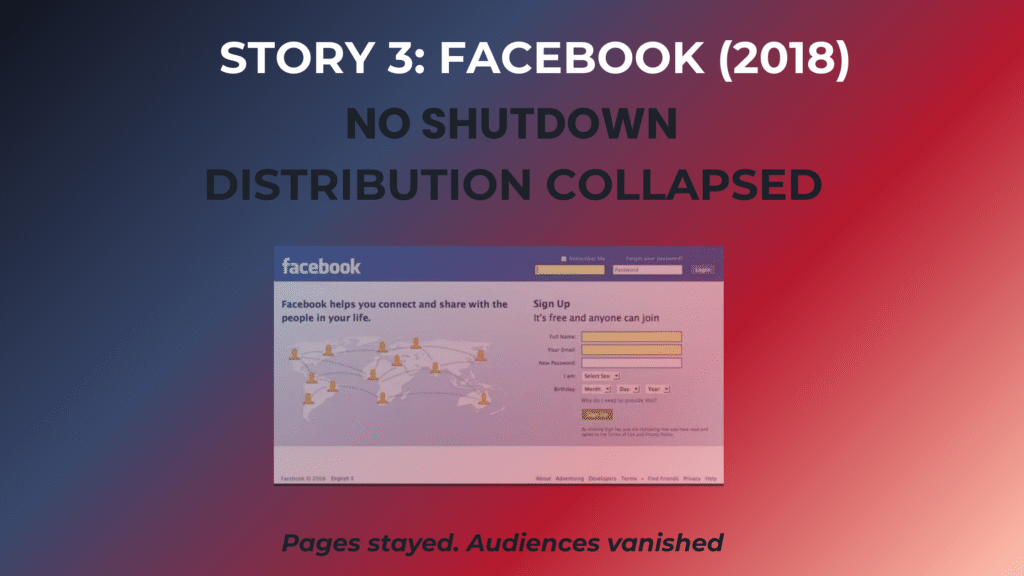
Facebook publicly announced a News Feed shift emphasizing friends/family (“meaningful social interactions”), which reduced reach for many brands and publishers.
Businesses didn’t lose Facebook accounts—they lost distribution.
Lesson: the most dangerous platform change is the one that keeps the lights on but turns down your visibility.
Is It a Merger, Takeover, or Joint Venture? What Actually Happened?
There has been a lot of confusion around TikTok’s U.S. situation in 2026, so let’s clarify it simply.
Is it a merger?
No. A merger means two companies combine into one. TikTok did not merge with Oracle or any other U.S. company.
Is it a takeover?
No. A takeover means one company buys another completely. TikTok’s parent company, ByteDance, did not sell TikTok outright and still keeps a minority ownership stake.
So what is it?
It is a joint venture / partial divestiture.
TikTok restructured its U.S. operations into a new U.S.-based company with majority ownership by U.S. and allied investors, while ByteDance retains a smaller stake. This structure was created to comply with U.S. national security laws and avoid a ban, not to shut the platform down. Reuters confirmed in January 2026 that TikTok reached this agreement to keep operating in the U.S. under a new governance model with
The real threat isn’t a ban it’s US TikTok uncertainty 2026.
The biggest threat is dependency.
If:
- 80–90% of your sales come from TikTok traffic,
- your brand deals rely only on TikTok metrics,
- your audience can’t find you anywhere else,
Then you’re operating on borrowed land.
And TikTok is not a small, stable hobby platform. It is a major ad and commerce machine. For example, industry reporting (via WARC data) projected TikTok ad revenue could reach ~$32.4B in 2025 if it avoided a U.S. ban.
Big money attracts big pressure: politics, regulation, audits, and restructures. That creates volatility for creators.
The mindshift creators must make now
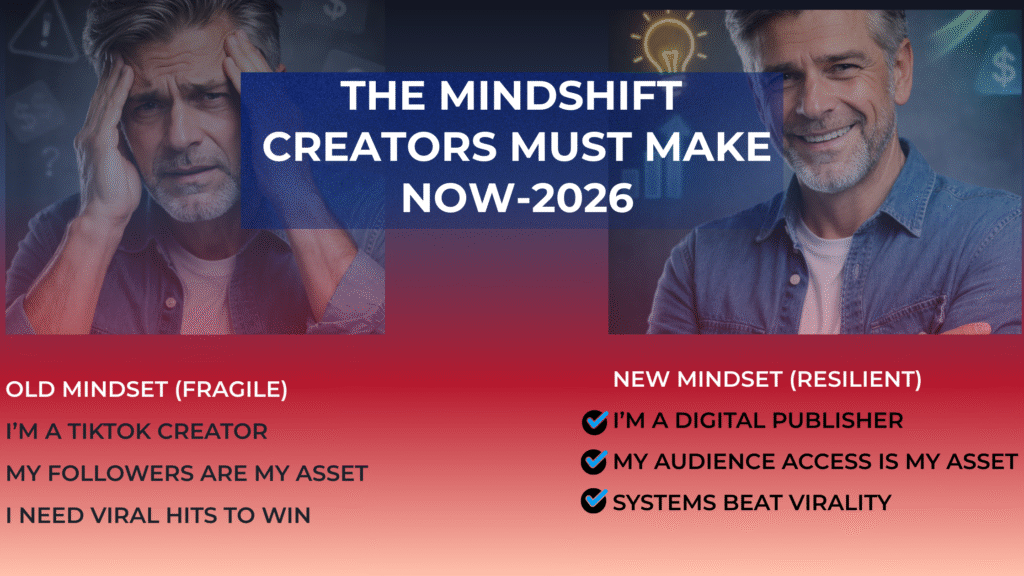
A proven strategy: The Creator Resilience Playbook (2026 edition)
Step 1 — Build a repeatable content system (not random posting)
Instead of asking “What should I post today?” build structure:
- 3 content pillars (your themes)
- 2 repeatable series (your formats)
- 1 CTA destination (where you send people)
Example for a digital product creator:
- Pillars: inspiration / education / product-use
- Series: “30-sec tips” + “before/after”
- CTA: Etsy listing or blog hub
This makes you consistent even when algorithms wobble.
Step 2 — Convert attention into an owned audience
This is where creators become durable.
Pick at least one:
- Email list
- Website/blog
- Community channel (WhatsApp/Discord/etc.)
- Customer list (Etsy/WooCommerce)
Why? Because platforms can throttle reach overnight (Facebook showed that), or restructure distribution rules (TikTok is literally doing this now).
Step 3 — Distribute across 3 lanes (not 1 platform)
This is the “anti-shock” strategy:
- Fast lane: TikTok / Reels (reach + trends)
- Evergreen lane: YouTube Shorts / Pinterest (search longevity)
- Ownership lane: blog + email (control)
When one lane slows, the others keep you alive.
Step 4 — Monetize like a business, not a platform user
Your income should not depend on a single algorithm.
Good 2026 creator income mix:
- Digital products (bundles, templates, SVGs)
- Affiliate links (selectively)
- Brand deals (once you have multi-platform proof)
- Services (optional; if you don’t want custom work, skip)
And remember: brands are increasing spend in creator media overall—so you’re not building in a shrinking market.
Frequently Asked Questions About US TikTok Uncertainty 2026
1. Will TikTok be around in 2026?
Likely yes,especially given the new U.S. joint venture structure designed to avoid a ban.
But “around” does not mean stable reach for creators.
2. What will happen to TikTok in 2026?
Expect continued changes around governance, audits, infrastructure, and possibly recommendation and policy enforcement in the U.S. entity model.
3. What will replace TikTok?
Nothing replaces TikTok one-to-one. When platforms change or disappear, creators don’t move to a single replacement—they spread their content across multiple platforms. Vine creators shifted to YouTube and Instagram. Periscope creators moved live content across other platforms. The pattern is clear: the replacement for TikTok is not another app, but a multi-platform strategy.
4.What if TikTok gets banned?
The creators who already have:
- An owned audience
- Multiple distribution lanes
- Product-based income experience disruption, not destruction.That’s the whole point of the mindshift.
Final takeaway
US TikTok uncertainty 2026 is not a reason to quit.
It’s a reason to grow up into a real creator business.
Use TikTok while it works.
Build so you’re fine if it doesn’t.
