Valentine trends 2026 are not shaped at the last minute. They form quietly through early search behavior, cultural shifts, and the way people plan meaningful moments ahead of time. They are already being shaped months earlier by how people search online, what they save for inspiration, and what they quietly start buying as the year begins. This shift is significant because Valentine’s Day remains one of the most important seasonal spending periods in the United States. In 2025, consumers were expected to spend $27.5 billion, according to the National Retail Federation.
Consumers are using AI more and more for product research, recommendations, and shopping exploration. Adobe for Business
Why January Shapes Valentine Trends 2026
Understanding valentine trends 2026 early gives creators time to design with intention instead of reacting when the season becomes crowded.
Although Valentine’s Day takes place in mid-February, consumer behavior shows that interest begins building much earlier. Search data and e-commerce analysis indicate that people start exploring Valentine’s-related ideas in January, using that time to plan and compare options rather than make last-minute decisions.
Etsy’s latest Valentine’s trend reporting shows that shoppers are moving away from generic gifts and gravitating toward items that feel personal, intentional, and emotionally meaningful. The data highlights growing interest in customized and thoughtful gestures, reinforcing that personalization has become a key expectation during Valentine’s season rather than a nice-to-have option.
How AI Is Shaping Valentine Trends 2026
In earlier years, predicting Valentine’s trends often meant copying what sold well the previous season. That approach is no longer reliable. Today, AI helps creators identify patterns in behavior rather than chase finished trends. When creators understand valentine trends 2026 early, they gain time to plan thoughtfully instead of reacting once demand peaks.
AI tools analyze how people phrase questions, which topics appear together, and how interest grows over time. Instead of focusing on one broad idea like “Valentine gift,” AI reveals clusters of intent such as gifts for friends, self-love themes, humorous couples, minimal romance, or long-distance relationships.
This insight allows creators to understand not only what people are searching for, but the emotional context behind those searches. That is what makes early forecasting possible.
This is why paying attention to valentine trends 2026 early gives creators a real advantage, allowing them to design with clarity instead of reacting when competition peaks.
The Signals That Shape Valentine’s Day Trends 2026:
Search behavior is often the earliest signal. Valentine’s-related searches increase throughout January as people explore ideas and refine preferences. AI helps by expanding short keywords into real questions people type and grouping those questions into meaningful themes. This allows creators to align content with intent before competition intensifies.
Marketplace behavior is the second signal. Platforms like Etsy analyze millions of searches and purchases to identify what shoppers respond to. When Etsy emphasizes personalization and thoughtful gifting, it reflects real buying behavior rather than aesthetic preference.
The third signal comes from social planning platforms. Pinterest functions as a planning engine where users save ideas long before they purchase. Pinterest publishes an annual trend forecast based on saving behavior, and the platform reports that many of its predictions later become mainstream.
Turning Early Signals Into Valentine Trends 2026:
A simple workflow is often all it takes to predict trends accurately. Creators start by paying attention to early signals such as what people are searching for, what is gaining traction on marketplaces, and which ideas are being saved on planning platforms. These signals reflect real intent rather than assumptions. AI then helps by organizing this information into a small number of clear themes, making it easier to see where interest is growing instead of reacting once a trend is already everywhere.
Once those themes are identified, the most important step is evaluating them through personalization. Today’s shoppers expect experiences to feel relevant to them as individuals. According to research from McKinsey, 71 percent of consumers expect personalized interactions, while 76 percent feel frustrated when experiences are not tailored to their needs. This explains why trends that support customization and emotional relevance consistently perform better. When people feel seen and understood, they are more likely to engage, remember the experience, and ultimately choose that product over something generic.
Trend Themes Influencing Valentine Trends 2026
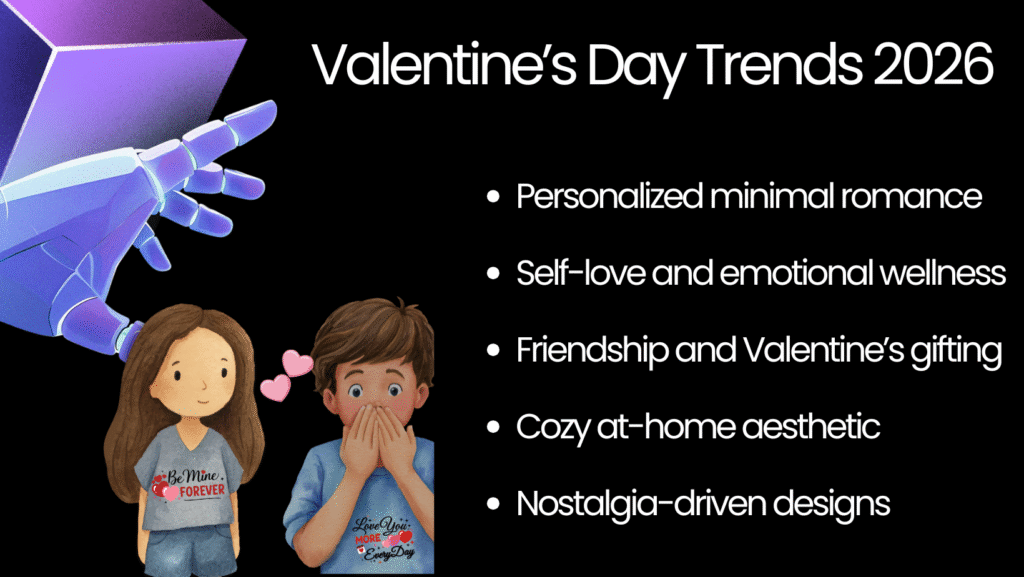
• Personalized minimal romance continues to lead because shoppers are actively choosing meaning over decoration. Clean typography, simple layouts, and quiet customization, such as names, dates, or meaningful locations reflect a wider move toward timeless design.
• Friendship and Valentine’s gifting is expanding as Valentine’s Day becomes less about couples and more about connection. Consumers are celebrating friends, siblings, and chosen families, driven by cultural shifts toward inclusivity and shared experiences.
• Self-love and emotional wellness themes are gaining momentum as conversations around mental health and balance move into everyday life. It is increasingly seen as a moment for self-recognition, care, and emotional grounding, mirroring broader wellness-focused lifestyle trends.
• Humorous and playful couple dynamics resonate because they feel real. Shoppers respond to light-hearted affection, inside jokes, and candid expressions that reflect everyday relationships. Humor removes pressure, increases relatability, and makes romantic messaging feel approachable rather than performative.
• Nostalgia-driven designs reflect a desire for emotional comfort and familiarity. Handwritten elements, memory-inspired themes, and references to shared moments create a sense of reassurance. In uncertain times, nostalgia functions as an emotional anchor rather than a visual trend.
• Dreamy and celestial romance aesthetics remain relevant as part of a growing interest in symbolism and escapism. These themes allow emotion to be expressed indirectly, offering softness and imagination instead of literal messaging, which appeals to consumers seeking mood-driven experiences.
• Soft winter color palettes and cozy at-home moments signal a shift toward intimacy over spectacle. Muted tones, warm neutrals, and calm color stories align with lifestyle reporting that emphasizes comfort, emotional safety, and slower living. Home and design publications continue to reinforce this inward-focused approach to seasonal expression.
Why Acting Early Matters in 2026:
Valentine’s Day trends 2026 are shaped long before February through search behavior, marketplace demand, and social planning signals. AI allows creators to see these signals sooner and act with confidence rather than guesswork. Creators who publish early are not predicting blindly. They are responding to real data while there is still room to stand out.
Frequently Asked Questions About Valentine’s Day Trends 2026
What are the trends for Valentine’s Day 2026?
Valentine’s Day trends 2026 focus heavily on personalization, meaningful gestures, and emotional relevance. Shoppers are gravitating toward gifts that feel intentional rather than generic, with strong interest in minimal romance, friendship gifting, self-love themes, and cozy shared experiences.
What will happen on Valentine’s Day 2026?
Valentine’s Day 2026 is expected to follow the same behavioral pattern seen in recent years, with most discovery and planning happening in January. Spending will continue to be significant, and personalized gifting will remain central to how people celebrate.
What is trending for Valentine’s Day 2025 and how does it influence 2026?
Trends from 2025 such as personalization, thoughtful gestures, and emotional storytelling are carrying forward into 2026. Rather than disappearing, these themes are evolving into more niche and specific expressions.
What are the consumer trends for Valentine’s Day?
Consumers increasingly expect personalization and emotional meaning. Research shows that people respond more positively to experiences that feel tailored to them, and frustration grows when personalization is absent.
What is the most popular thing on Valentine’s Day?
Experiences and personalized gifts consistently rank among the most popular choices. Shoppers are less focused on generic items and more interested in gifts that reflect relationships and shared moments.
What trends will be popular in 2026 overall?
In 2026, broader consumer trends emphasize personalization, AI-assisted discovery, emotional wellness, and intentional purchasing. Valentine’s Day trends reflect these same priorities in a seasonal context.
What is the theme of Valentine’s Day in 2025 and how does it compare to 2026?
The theme of Valentine’s Day in 2025 centered around meaningful gestures and personalization. In 2026, this theme continues but becomes more refined, with greater emphasis on niche relationships, humor, and self-expression.
What day is Valentine’s Day in 2026?
Valentine’s Day in 2026 falls on Saturday, February 14, making it particularly well suited for shared experiences and weekend celebrations.
How much do people spend on Valentine’s Day?
In 2025, U.S. consumers were expected to spend $27.5 billion on Valentine’s Day, with an average of $188.81 per person. Spending levels for 2026 are expected to remain strong as gifting continues to be emotionally driven.
Is consumer spending going up or down for Valentine’s Day?
Overall Valentine’s Day spending has remained resilient, even during periods of economic uncertainty. Consumers may become more selective, but they continue to prioritize meaningful purchases.
Final Thoughts
Valentine’s Day trends 2026 are not shaped at the last minute. Deeper lifestyle shifts actively shape valentine trends 2026.What stands out this year is not a single aesthetic, but a clear move toward intention. Shoppers are gravitatin g toward expressions that feel personal, thoughtful, and emotionally grounded rather than generic or overly produced.
For creators, this shift creates space to approach Valentine’s design with more clarity and less urgency. Understanding trends early allows time to create work that reflects connection, humor, and simplicity without chasing what suddenly feels popular in February. When designs align with real emotion, they tend to resonate longer and more naturally.
You’ll notice that some independent studios quietly curate collections around these emerging Valentine styles, offering an easier way to explore what is resonating this season before trends feel crowded or overexposed. Often, these collections reflect the signals early, long before they become obvious to everyone else.
Valentine’s Day does not need to be loud to be meaningful. The most memorable expressions are often the ones that feel considered, personal, and intentionally chosen.
Many of the strongest valentine trends 2026 are already visible months before February for those paying attention.
If you’re curious to see how these ideas take shape in practice, you can explore one such curated collection here.