
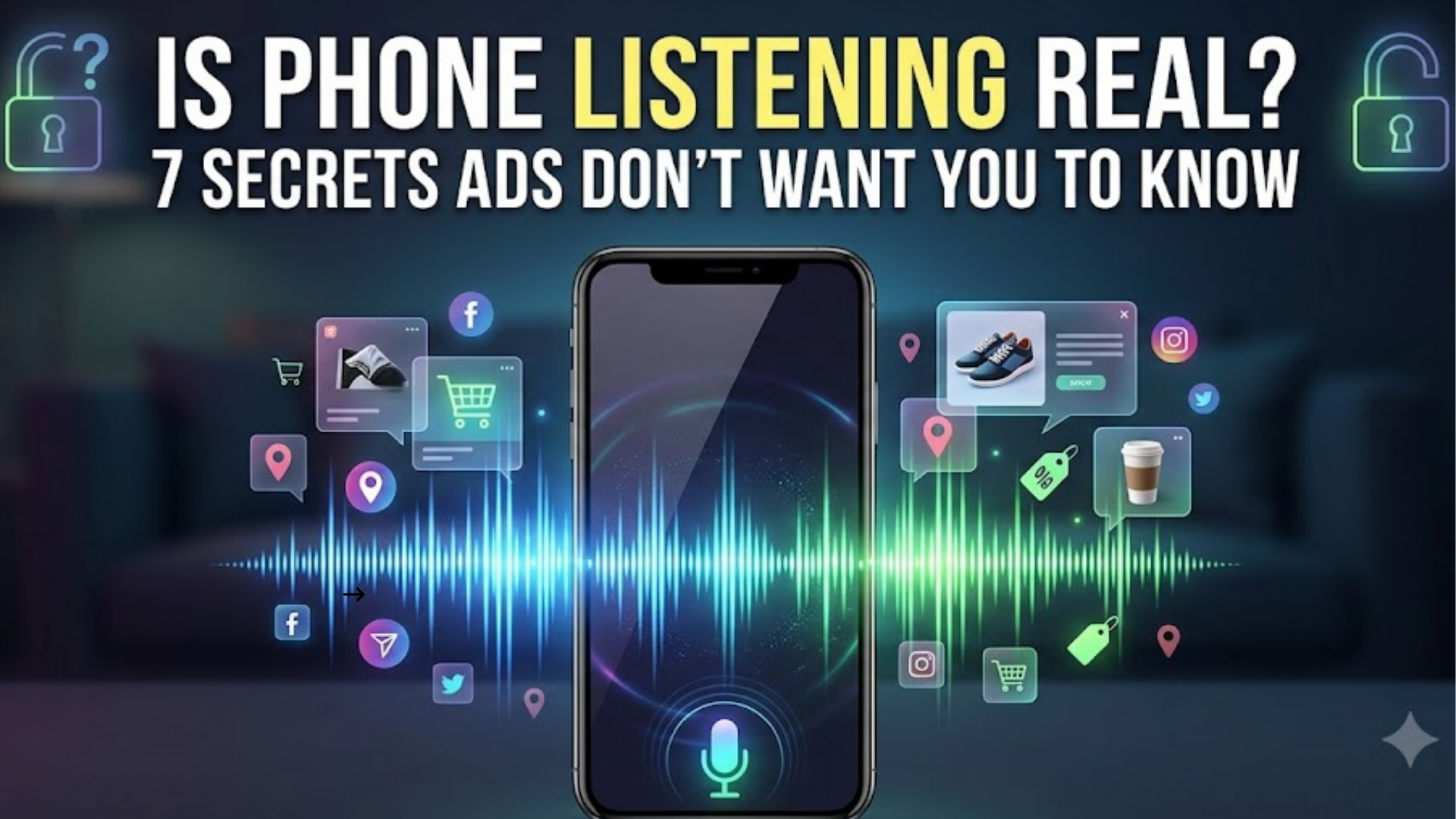
Phone listening is the theory that your phone secretly turns on its microphone and feeds your conversations into ad targeting. You say a product name out loud. Minutes later, an ad for that exact product pops up in your feed. It feels like proof.
This experience is so common that researchers gave it a name: the phone listening myth. In fact, 48% of Americans believe their phone listens to them, and a similar share say they’ve seen ads for things they only said out loud. Yet the hard evidence tells a different story. That story is arguably more unsettling than a microphone quietly recording your dinner conversation.
This post breaks down what phone listening really means, why the myth spreads so fast, and seven honest secrets the ad industry rarely explains. We’ll close with the key figures behind the debate, plus quick answers to the questions people search most.
What “Phone Listening” Actually Means
Most people describe phone listening the same way. An app secretly turns on your microphone. It scans your speech for keywords. Then it uses those words to target you with ads.
That’s a specific claim, and researchers have tested it more than once. So far, no one has caught a mainstream app doing this at scale. A Northeastern University study analyzed over 17,000 Android apps, including many tied to major ad networks. The team found zero cases of secret audio transmission for ads.
They did find something else instead. That’s secret number one.

Your phone doesn’t need your voice. It already tracks your typing, your searches, your location history, and every app you open. That’s a far richer signal than a few overheard words.
Every tap, scroll, and pause builds your profile. Advertisers don’t need audio when they already hold a running transcript of your digital life. This is exactly why muting your microphone rarely changes the ads you see.

Every time a webpage loads, an ad auction fires in the background. It takes milliseconds. Advertisers bid for the right to show you an ad, based entirely on your existing profile.
Privacy researchers call this system real-time bidding, and they rank it among the most invasive tools in modern advertising. The Electronic Frontier Foundation has flagged real-time bidding for exposing personal data to thousands of buyers with every single page view. It doesn’t need your microphone. It just needs your browsing footprint, which is already for sale.

Here’s a scenario that fools almost everyone. Your partner searches for a product. Later, the same ad shows up on your phone. It looks like your phone eavesdropped on your shared conversation.
Shared Wi-Fi networks, shared devices, and overlapping app permissions blur the line between household members. Ad systems often can’t tell you apart from someone else on the same network. People misread that coincidence as surveillance.

An entire industry exists just to package and resell your personal information. Data brokers combine loyalty card records, public documents, and app permissions into detailed profiles, then sell those profiles straight to advertisers.
So your “eerily accurate” ad probably isn’t a guess. It’s likely a purchase, built from data you agreed to hand over the moment you clicked “accept” on a privacy policy you never read.

Here’s where the phone listening story gets genuinely interesting. In 2024, Cox Media Group promoted a product called “Active Listening.” The pitch claimed it could target ads using voice data pulled from smart devices. Google pulled the company from its partner program soon after journalists started asking questions.
The story didn’t end there. In May 2026, the Federal Trade Commission accused Cox Media Group and two other companies of deceiving their own advertising clients. The FTC found the companies had falsely claimed they could analyze consumer conversations, when that capability never actually existed. The real fraud wasn’t secret listening. It was selling the idea of secret listening to advertisers who wanted to believe it.

Not every researcher agrees the myth is pure fiction. A small academic study run by Esade placed 27 participants in small groups near an active phone microphone. Across 10 scripted, 10-minute conversations about travel topics, the team checked whether related ads showed up afterward.
The results raised eyebrows, though the sample size was tiny and the setup was tightly scripted. Most cybersecurity experts still doubt this reflects everyday phone use. Even so, it explains why the debate hasn’t fully settled, and why healthy skepticism runs in both directions.

Maybe the most important secret isn’t technical at all. It’s psychological. When an ad feels too accurate, our brains reach for the simplest explanation. “My phone is listening” sounds simpler than “dozens of data points about me just got auctioned in a millisecond.”
People often choose a simple, human-sounding story over untangling a complex system. Phone listening works as a modern folk theory. It fills a gap left by years of unclear ad-tech disclosures, and that gap won’t close until companies explain their targeting methods in plain terms.
This same pattern shows up whenever a complex system feels too tangled to question. We covered that instinct in more depth in our piece on AI dependence and critical thinking, where outsourcing judgment to a simple story often replaces the harder work of checking the evidence.
Show Image
The Figures Behind the Phone Listening Debate
- 48% of Americans believe their phone actively listens to them for ad targeting.
- 48% report seeing ads for topics they only discussed out loud, never searched online.
- 17,000+ Android apps were audited by Northeastern University researchers, with zero confirmed cases of covert microphone-based ad targeting.
- 3 companies, including Cox Media Group, faced FTC action in May 2026 for falsely marketing conversation-based ad targeting.
- 27 participants and 10 scripted sessions made up the Esade study that reported a possible link between spoken keywords and later ads.
- 10% is the maximum passive-voice ratio most readability tools recommend for clear, easy-to-read content.
These numbers tell one consistent story. Millions of people believe phone listening is real. Confirmed technical proof of microphone-based targeting still doesn’t exist. What is confirmed is a data economy that doesn’t need to listen, because it already watches everything else you do.
Phone Listening: (Q&A)
1. Is phone listening real, or is it a myth?
No confirmed evidence shows that mainstream apps secretly use your microphone for ad targeting. Independent researchers and tech companies both point to browsing data, location history, and shared devices as the real source of targeted ads.
2. Why do ads feel like they’re based on conversations I’ve had?
Ad systems combine your search history, app activity, location data, and household network signals. When a partner or family member searches for something, you can see the same ad too, which creates the illusion of phone listening.
3. Did any company actually get caught doing voice-based ad targeting?
Not exactly. Cox Media Group marketed a voice-targeting product called “Active Listening,” but the FTC ruled in 2026 that the company had misrepresented its capabilities to advertisers rather than actually analyzing conversations.
4. Can I stop my phone from “listening” to me?
You can limit microphone permissions in your phone’s privacy settings, though this mainly blocks voice-assistant access. Since most targeting relies on browsing and app data, reviewing your ad personalization settings makes a bigger difference.
5. Does turning off microphone access change the ads I see?
Usually, no. Targeting relies mainly on non-audio data, so disabling your microphone rarely produces a noticeable drop in ad relevance.
Final Thought on Phone listening
Phone listening makes a great conspiracy theory because it has a villain you can picture: a microphone, quietly recording. The truth runs less cinematic and more systemic. Advertisers use your data trail, not your voice.
That difference matters. It shifts the real question from “is my phone listening” to “what data am I actually sharing, and with whom.” That’s a harder question, but it’s the one worth answering.
