
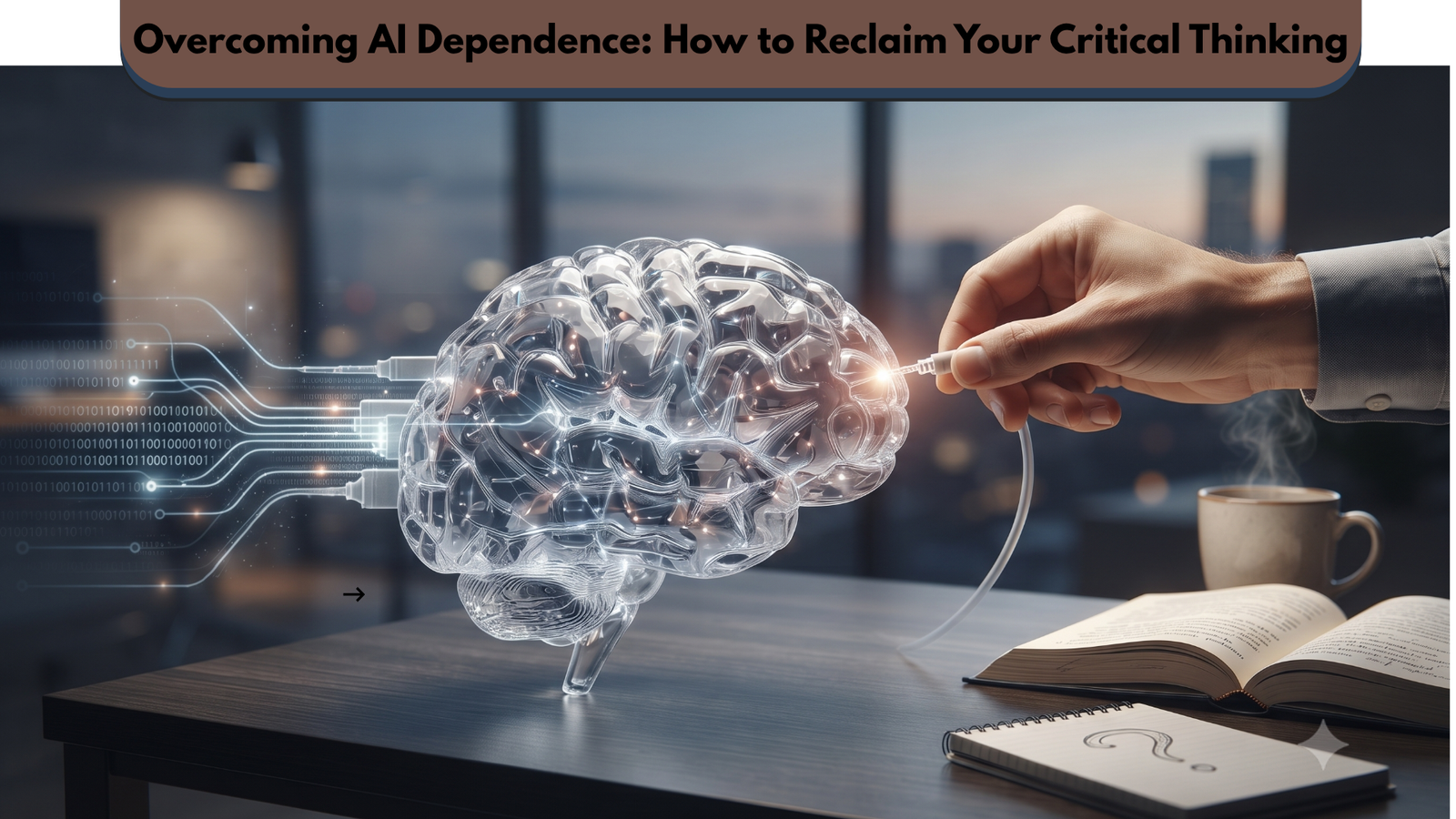
AI dependence starts small. You ask a question, a chatbot answers instantly, and you copy, paste, and move on. It feels efficient. However, this small, repeated habit is quietly reshaping how millions of people think, decide, and solve problems in 2026.
AI dependence is no longer a fringe worry reserved for tech ethicists. It is now a measurable, well-documented shift in human cognition, and researchers across neuroscience, education, and workplace psychology are racing to understand it. The good news? AI dependence is not a life sentence. With a few deliberate habits, you can keep using AI tools and keep your mind sharp. This guide walks through the latest 2026 research, the warning signs to watch for, and a practical, step-by-step plan to reclaim your critical thinking.
What Is AI Dependence, and Why Is It Rising in 2026?
AI dependence describes the growing tendency to offload thinking tasks writing, analyzing, deciding, even remembering onto AI tools rather than doing the cognitive work yourself. Researchers call the underlying mechanism cognitive offloading: delegating a mental task to an external system to save effort.
Offloading itself is not new; we have always used calculators and search engines. What is different in 2026 is the scale. According to the International AI Safety Report 2026, everyday chatbot use now spans writing, tutoring, problem-solving, and information-seeking, and when these tasks are routinely handed off, users may engage less deeply with the underlying reasoning involved. In other words, the more capable AI becomes, the easier it is to stop thinking altogether and that trade-off is exactly what today’s research is measuring.
The Science: How AI Dependence Rewires Your Brain
If you want proof that AI dependence has a physical footprint, look no further than MIT Media Lab’s landmark 2025–2026 study, Your Brain on ChatGPT. Researchers split participants into three groups one using an LLM, one using a search engine, and one writing unassisted and tracked their brain activity with EEG across several months.
The results were stark. Brain connectivity scaled down in direct proportion to how much external support a person used: the unassisted group showed the strongest, widest-ranging neural networks, the search-engine group showed moderate engagement, and the AI-assisted group showed the weakest connectivity of all. Even more concerning, when the AI-assisted group was later asked to write without help, their brains still showed severe deficits in memory and a sense of ownership over their own writing, with the vast majority unable to accurately quote work they had just produced.
This is not “brain rot” in a dramatic sense the researchers are careful to note that. Still, it does suggest something researchers now call cognitive debt: mental shortcuts that feel free in the moment but accrue a cost you notice later, much like financial debt.
The 2026 Data: AI Dependence and Critical Thinking, By the Numbers
Beyond the MIT study, a wave of 2026 research confirms the same pattern from different angles:
| University students. A study of 580 Chinese university students found that greater AI dependence was associated with lower levels of critical thinking, with cognitive fatigue partially explaining the relationship. |
| Healthcare workers. A multicenter study of nursing interns found a meaningful link between AI dependence and critical thinking ability, but crucially, AI literacy partially buffered the negative relationship meaning people who understood how AI actually worked were more resistant to the downside. |
| Knowledge workers. A January 2026 Wharton School paper coined the term “cognitive surrender” to describe knowledge workers who adopt AI outputs with minimal scrutiny, overriding both intuition and deliberate reasoning. The same reporting notes that an earlier Microsoft Research study found confidence in an AI tool was one of the strongest predictors of whether a worker engaged in critical thinking at all the more people trusted the tool, the less they questioned. |
| Clinical skill decay. Perhaps the most sobering data point: the International AI Safety Report 2026 cites a study showing that just three months after AI support was introduced, clinicians’ ability to detect tumors without AI assistance had already dropped by. |
Together, these findings paint a consistent picture. AI dependence does not switch off your critical thinking overnight. Instead, it erodes it gradually, one small offloaded decision at a time.
Signs You Might Be Over-Relying on AI
Before you can reclaim your critical thinking, it helps to recognize where AI dependence has already crept in. Watch for these patterns:
| 1. You accept the first AI answer without checking it | This mirrors the “cognitive surrender” pattern researchers describe. |
| 2. You cannot explain your own conclusions. | If you cannot summarize why something is true without re-opening the chat, you likely didn’t process it you just relayed it. |
| 3. You feel anxious without AI access. | A sense of unease when the tool is unavailable is a classic dependence signal. |
| 4. You skip the “struggle phase” of hard problems. | The discomfort of not knowing is exactly where critical thinking develops; skipping it consistently prevents the skill from forming. |
| 5. Your first move on any task is opening a chatbot, | rather than thinking, sketching, or drafting first. |
How to Reclaim Your Critical Thinking: 7 Actionable Steps
Reclaiming your critical thinking does not mean abandoning AI. Instead, it means changing the order of operations thinking first, then verifying with AI, rather than the reverse.
1. Draft Before You Delegate

Before opening any AI tool, spend five minutes writing your own first attempt a hypothesis, an outline, a rough answer. This single habit preserves the “brain-only” cognitive engagement researchers found was strongest in the MIT study, while still letting you use AI to refine the result afterward.
2. Use the “Explain It Back” Test

After AI gives you an answer, close the chat and explain the reasoning out loud, in your own words, without looking. If you cannot, you have not actually learned it you have only borrowed it temporarily.
3. Treat AI as a Sparring Partner, Not an Oracle

Ask AI to challenge your thinking rather than replace it. Prompts like “What’s the strongest argument against my conclusion?” force you to engage critically with the response instead of passively accepting it.
4. Build Your AI Literacy

Research consistently shows that people with stronger AI literacy experience a weaker negative effect from AI dependence. Understanding how these models generate answers including their tendency to sound confident even when wrong naturally makes you a more skeptical, careful user.
5. Schedule “Unplugged” Thinking Blocks

Set aside specific tasks each week a report, a decision, a problem that you deliberately complete without any AI assistance. This is the digital equivalent of exercise: skills that go unused start to atrophy, and skills that are practiced regularly stay strong.
6. Verify, Don’t Just Trust

Before acting on an AI-generated answer for anything important, cross-check it against at least one independent source. This single step interrupts the “minimal scrutiny” pattern the Wharton researchers flagged as the core of cognitive surrender.
7. Protect the “Struggle Phase”

When you hit a hard problem, resist the urge to immediately ask AI. Give yourself 10–15 minutes of genuine effort first. That discomfort is not wasted time it is the exact mechanism through which critical thinking skills are built and maintained.
AI Dependence Is Also Reshaping How We Work
AI dependence is not just a classroom or personal-productivity issue; it is unfolding against the backdrop of a genuinely disrupted global economy. As traditional roles shift and more of the workforce moves toward remote and AI-assisted work, understanding how to use these tools critically rather than passively has become a practical career skill, not just an academic one. If you are exploring how these economic shifts are changing income opportunities and remote work more broadly, this breakdown of the 2026 work-from-home landscape is a useful next read.
Quick Answers on AI Dependence
1. What is AI dependence?
AI dependence is the habitual offloading of thinking tasks writing, analysis, decision-making onto AI tools, which research links to reduced critical thinking over time.
2. Does AI use actually lower critical thinking?
2026 research from MIT, Wharton, and multiple university studies links heavier AI reliance to weaker critical thinking scores, reduced brain connectivity, and lower memory recall of AI-assisted work.
3. How can I reduce AI dependence?
Draft your own answer before consulting AI, verify AI outputs against independent sources, explain conclusions in your own words, and schedule regular tasks completed without AI assistance.
4.Is AI dependence permanent?
No. Studies show AI literacy and deliberate “unplugged” practice can buffer or reverse the effect, meaning critical thinking skills can be rebuilt with consistent habits.
Final Thought on AI Dependence
AI is not going away, and it should not have to. Used well, it is one of the most powerful thinking tools ever built. However, the 2026 research is clear: used passively, it quietly trades your long-term cognitive strength for short-term convenience. The goal is not to reject AI it is to stay firmly in the driver’s seat while using it. Draft first. Question everything. Practice thinking the hard way, on purpose, often enough that the skill never fades.
References
- Kosmyna, N., et al. (2025–2026). Your Brain on ChatGPT: Accumulation of Cognitive Debt when Using an AI Assistant for Essay Writing Task. MIT Media Lab. https://www.media.mit.edu/publications/your-brain-on-chatgpt/
- International AI Safety Report 2026. Decision-making competence in AI-mediated environments. https://arxiv.org/pdf/2602.21012
- Tian, J., & Zhang, R. (2026). Learners’ AI dependence and critical thinking: The psychological mechanism of fatigue and the social buffering role of AI literacy. Acta Psychologica. https://www.sciencedirect.com/science/article/pii/S0001691825010388
- Frontiers in Psychology (2026). The association between AI dependence, AI literacy, and critical thinking ability among nursing interns. https://www.frontiersin.org/journals/psychology/articles/10.3389/fpsyg.2026.1823047/full
- Rosenberg, C. (2026). AI Is Eroding Critical Thinking At Work. The Window Is Closing. Forbes. https://www.forbes.com/sites/chrisrosenberg/2026/05/28/ai-is-eroding-critical-thinking-at-work-the-window-is-closing/
- Gerlich, M. (2025). AI Tools in Society: Impacts on Cognitive Offloading and the Future of Critical Thinking. https://www.psypost.org/ai-tools-may-weaken-critical-thinking-skills-by-encouraging-cognitive-offloading-study-suggests/
- Color Uncover (2026). Work From Home 2026: 7 Ways the Global Economy Is Making It Happen. https://coloruncover.com/work-from-home-2026/

Pingback: What is Physical AI? 5 Ultimate Tech Examples
Pingback: Is Phone Listening Real 7 Secrets Ads Don't Want You to Know