
Key Takeaways: Financial Security in 2026
Before diving deeper, here are the key insights shaping financial security in 2026:
- Global conflicts and geopolitical tensions are increasing uncertainty in energy markets and supply chains.
- Inflation, interest rates, and commodity prices remain major economic variables influencing household finances.
- Market volatility may increase, but long-term economic growth trends continue globally.
- Individuals can strengthen financial security in 2026 through diversified income sources, savings discipline, and long-term investment strategies.
- Preparation and financial resilience matter more than predicting economic events.
Introduction: Why Financial Security in 2026 Is Becoming a Global Concern
Rising geopolitical tensions and energy market volatility are increasing concerns about financial security in 2026. When conflicts escalate in energy-producing regions, oil and gas prices often react quickly, affecting transportation, manufacturing, and food production costs. These shifts eventually influence inflation and everyday household expenses. According to the U.S. Energy Information Administration (EIA), global oil prices and supply disruptions remain key drivers of economic volatility because energy costs influence nearly every sector of the economy.
Global inflation surged after the pandemic and remains above long-term averages in many economies. Rising prices reduce purchasing power and affect household budgets, making financial planning more difficult for families worldwide. As inflation influences wages, savings, and everyday expenses, households and investors are increasingly focused on protecting their finances and strengthening financial security in 2026 in an uncertain global economic environment.
Global Conflict and Rising Economic Uncertainty and Financial Security in 2026
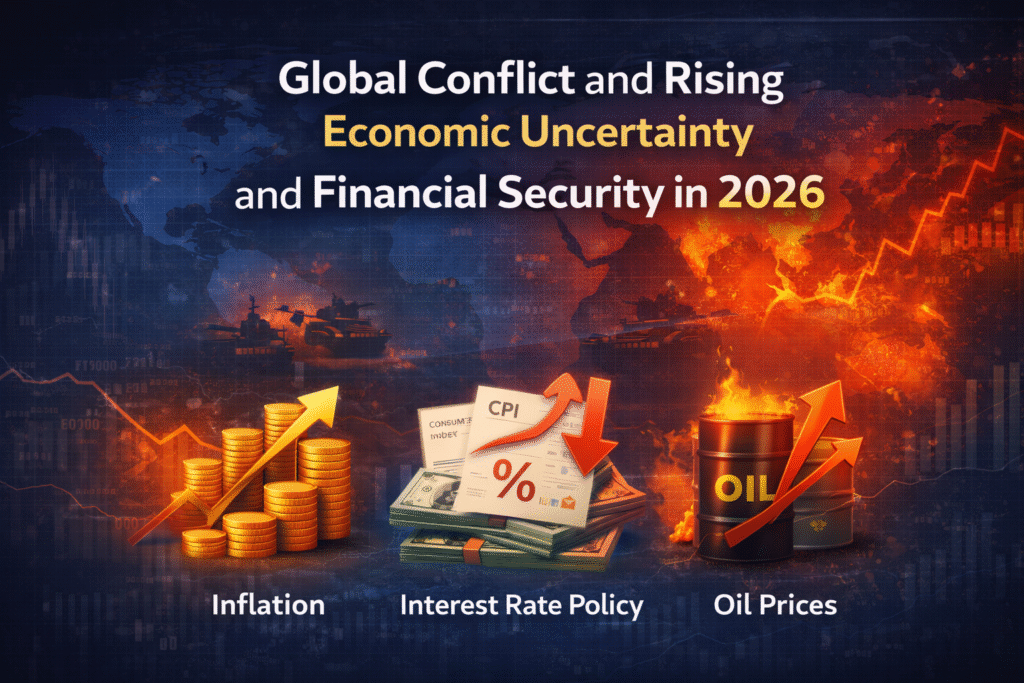
Geopolitical instability has historically influenced financial markets and economic confidence. In today’s interconnected global economy, conflicts affecting energy production, trade routes, or international relations can quickly disrupt supply chains and trigger market volatility.
Key economic indicators economists monitor during geopolitical tensions include:
- Oil and energy prices – Energy markets often react first to geopolitical disruptions.
- Inflation trends – Rising fuel and transportation costs can increase consumer prices globally.
- Global trade flows – Conflicts can disrupt shipping routes and international supply chains.
- Interest rate policies – Central banks adjust interest rates to control inflation and stabilize growth.
Recent global economic forecasts highlight the scale of these pressures:
- The International Monetary Fund (IMF) projects global economic growth to remain relatively stable at around 3.3% in 2026, supported by technological investment and resilient labor markets.
- Global inflation is expected to decline gradually from about 4.1% in 2025 to around 3.8% in 2026, though still above pre-pandemic levels.
- According to the International Energy Agency (IEA), global oil supply could rise to roughly 108.6 million barrels per day in 2026 as production increases worldwide.
- Approximately 20% of the world’s oil and gas trade passes through the Strait of Hormuz, meaning geopolitical tensions in the region can significantly influence global energy prices and inflation expectations.
While economists continue to debate whether rising geopolitical tensions could trigger a broader economic slowdown or financial crisis, there is broad agreement that economic uncertainty is likely to remain elevated in the coming years.to perfectly predict economic cycles.
What Are the Odds of a Recession in 2026?
Recession predictions vary depending on economic indicators. Key signals economists watch include:
- GDP growth rates
- Unemployment trends
- Consumer spending
- Inflation levels
If inflation remains high and interest rates stay elevated, economic growth could slow in some regions. However, many major economies also continue to show resilience through strong labor markets and technological innovation.
Because of this mixed outlook, most economists suggest that moderate economic slowdowns are possible, but severe global recessions remain uncertain.
The most practical approach for households is therefore strengthening financial security in 2026 through preparation rather than speculation.
How Economic Uncertainty Could Affect Everyday Expenses
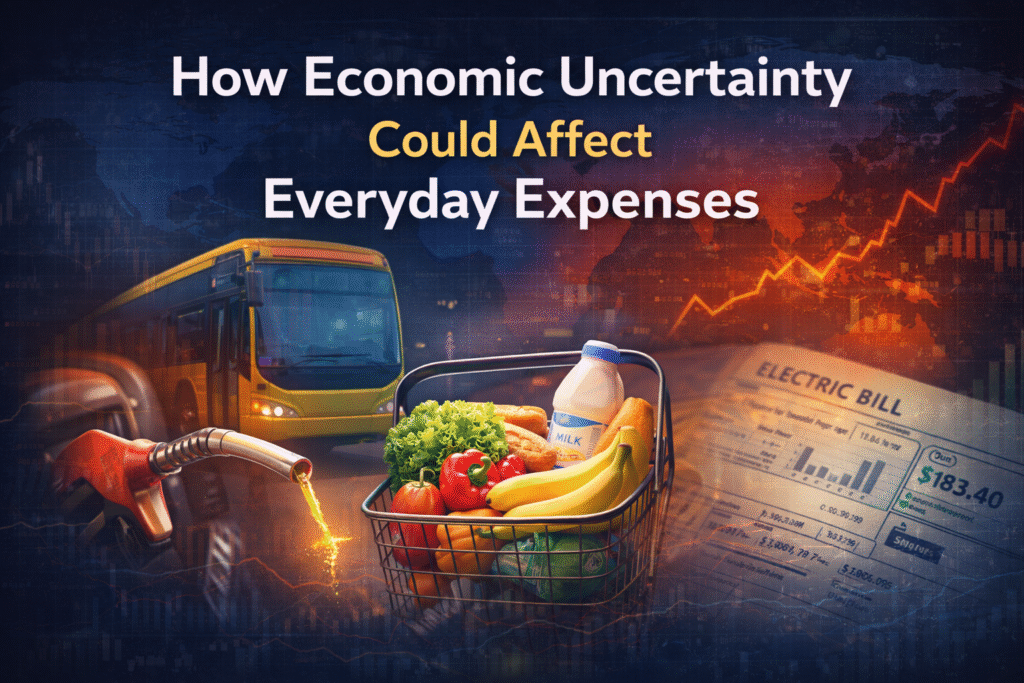
Economic uncertainty does not only affect investors or financial markets. It often appears first in everyday household expenses such as transportation, food, and utilities.
Energy price fluctuations can influence several key costs:
- Transportation costs – fuel prices affect shipping and logistics.
- Grocery prices – food supply chains depend heavily on transportation and energy.
- Electricity and utility bills – energy market volatility directly affects household utility prices.
- Manufacturing costs – higher energy prices increase production costs across industries.
For example, higher fuel prices increase the cost of transporting food and goods, which can lead to higher grocery prices for consumers.
Recent global data shows how volatile food and energy costs can be. According to the FAO Food Price Index, global food commodity prices averaged 123.9 points in early 2026, reflecting continued volatility in cereals, vegetable oils, and other staple commodities.
Households aiming to maintain financial security in 2026 often respond by focusing on budgeting, reducing unnecessary expenses, and building savings buffers that can absorb short-term economic shocks.
Where Is Your Money Safest During Economic Uncertainty?
One of the most common questions people ask during uncertain economic periods is where their money should be placed.
Historically, the most effective strategy has been diversification. Instead of concentrating resources in one area, diversification spreads financial risk across multiple assets and income sources.
A balanced financial strategy may include:
- Emergency savings funds
- Diversified investment portfolios
- Retirement savings plans
- Stable income sources
Financial planners widely recommend maintaining 3–6 months of emergency savings, which can help households navigate temporary income disruptions or economic volatility.
This approach helps maintain financial security in 2026 even when specific markets or sectors experience temporary downturns.
Is 2026 Going to Be a Good Financial Year?
Predicting whether a year will be economically strong or weak is difficult because many variables interact simultaneously.
Positive factors influencing global growth include:
- Technological innovation
- Expanding digital economies
- Growing global connectivity
- Advancements in artificial intelligence and automation
These trends also connect directly to the rise of new digital careers and income opportunities. In a previous article, we explored how technological transformation is reshaping the workforce in Energy Crisis and AI: 7 Future Digital Skills That Will Survive Geopolitics.
At the same time, geopolitical tensions and energy market disruptions may create periods of volatility.
Because of this balance between opportunity and uncertainty, financial experts often emphasize long-term planning rather than short-term predictions when thinking about financial security in 2026.
Where Should You Put Your Money in 2026?
Investment decisions depend on personal goals, risk tolerance, and time horizon.
Financial experts frequently recommend focusing on strategies such as:
- long-term investment planning
- Diversification across industries and asset types
- Consistent savings contributions
- Avoiding emotionally driven financial decisions
Individuals who maintain disciplined financial strategies often experience more stable results over time, even during periods of economic volatility.
These principles play a crucial role in maintaining financial security in 2026.
How to Stay Financially Stable in 2026

While global economic conditions may change, several fundamental principles consistently help individuals maintain financial stability.
Some practical steps include:
1. Build an Emergency Fund
Savings that cover several months of living expenses can provide security during economic disruptions.
2. Diversify Income Sources
Relying on multiple income streams can reduce financial vulnerability.
3. Maintain Long-Term Investments
Consistent investing often produces better results than attempting to time markets.
4. Manage Debt Carefully
High interest debt can become more difficult to manage when economic conditions tighten.
By focusing on these fundamentals, individuals can strengthen their financial security in 2026 regardless of global economic fluctuations.
Financial Market Outlook for 2026
Economic forecasts suggest that the global economy will likely continue evolving through a mix of innovation, competition, and geopolitical complexity.
Several trends expected to influence markets include:
- Technological transformation across industries
- Evolving energy systems and sustainability transitions
- Continued globalization of digital services
- Changing labor markets and remote work economies
These developments may create both challenges and opportunities for individuals seeking long-term financial stability.
Understanding these trends helps individuals make informed decisions that support financial security in 2026.
Conclusion: Building Financial Security in 2026 in an Uncertain World
Global conflicts and economic uncertainty can create significant volatility in financial markets and everyday expenses. However, history consistently shows that individuals who focus on preparation, diversification, and disciplined financial planning are better positioned to navigate uncertain environments.
Instead of trying to predict every economic shift, individuals can strengthen financial security in 2026 by developing resilient financial strategies that adapt to changing conditions.
In a world shaped by geopolitical complexity and rapid technological change, financial resilience remains one of the most valuable assets individuals can build.
FAQ: Financial Security in 2026

1. Is a financial crisis coming in 2026?
There is no confirmed prediction of a global financial crisis, but economic uncertainty remains influenced by inflation, energy markets, and geopolitical tensions.
2. What are the odds of a recession in 2026?
Economic forecasts vary. Some analysts expect moderate slowdowns while others predict continued growth with volatility.
3.Will grocery prices go up in 2026?
Food prices may fluctuate depending on energy costs, supply chains, and agricultural production.
4.Where is money safest during a recession?
Diversified financial strategies, savings buffers, and long-term investments are commonly recommended approaches during uncertain economic periods.
5. How can individuals improve financial security in 2026?
Building emergency savings, maintaining diversified income sources, managing debt responsibly, and focusing on long-term financial planning can help strengthen financial
