
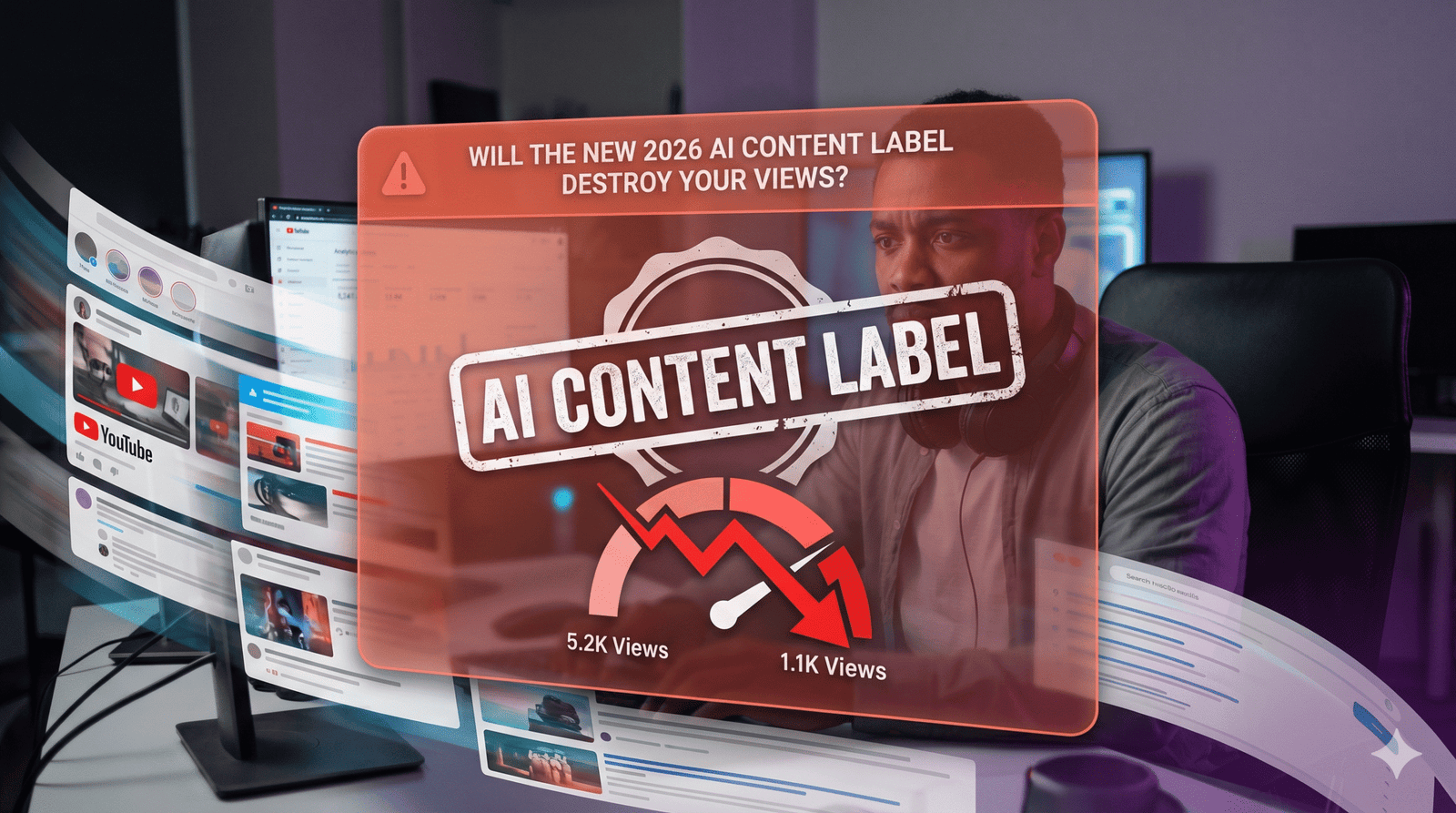
| 94%consumers demand AI disclosure | Aug 2 EU AI Act label deadline 2026 | 21%of YouTube Shorts are AI-generated | 36%say AI videos lower brand perception |
Introduction: The AI Content Label Revolution Is Already Here
If you are a content creator, digital marketer, or brand manager, you have probably already heard the phrase AI content label more times this year than you care to count. However, what most creators still do not fully understand is how radically these new 2026 rules will reshape their reach, revenue, and reputation across every major social platform.
First of all, let us look at the facts. According to a 2024 consumer survey, 94% of consumers said all AI-generated content should be disclosed yet until 2025, most platforms relied entirely on voluntary creator disclosure. That era is now officially over. Starting August 2, 2026, the EU AI Act’s Article 50 makes the AI content label legally mandatory. It covers texts, images, audio, and video. The rule applies to every platform no exceptions.
Furthermore, the scale of the problem these rules aim to solve is staggering. Meanwhile, when researchers simulated a fresh YouTube account in late 2025, 21% of the first 500 Shorts recommended were outright AI-generated, with another 33% classified as low-effort “brainrot” content.
| “AI slop” was named Word of the Year for 2025 by both Merriam-Webster and Australia’s national dictionary, a signal of just how deeply synthetic content has flooded our digital lives. Merriam-Webster & Macquarie Dictionary, 2025 |
Related Reading: Robotics in Healthcare: Advanced Nations & Human Value
What Exactly Is an AI Content Label in 2026?
An AI content label is a visible or machine-readable disclosure marker attached to any piece of content that has been substantially created or modified by artificial intelligence. Specifically, the EU AI Act’s Article 50 establishes a dual labeling system: one machine-readable layer (embedded as metadata, using standards like C2PA) and one human-visible layer (a clear on-screen notice) for content that directly interacts with users.
| 📌 What Triggers an AI Content Label Under EU Law? Fully AI-generated text, images, audio, or video content AI-cloned or synthetic voices resembling real people Deepfakes or heavily AI-altered footage of real individuals AI-generated news or public-interest informational content Any “hybrid” content where AI made a significant contribution |
The 2026 AI Content Label Mechanism on Every Major Social Platform

1.🎬 YouTube: Mandatory Disclosure or Demonetization
YouTube introduced its AI disclosure policy in March 2024 and began active enforcement in early 2025. Mandatory AI content label disclosures for altered or synthetic content went fully live in 2026, with channels that failed to label facing reduced recommendations and possible removal from the YouTube Partner Program.
A Kapwing study of 15,000 trending YouTube channels found 278 channels producing only AI-generated content. Together, they racked up 63 billion views and 221 million subscribers. Their estimated annual ad revenue hit $117 million.YouTube’s CEO Neal Mohan pledged to crack down on “AI slop” in his January 2026 annual letter. The algorithm now penalizes low-effort, mass-produced AI content regardless of labeling status
2.📸 Meta (Facebook, Instagram, Threads) C2PA Detection + Self-Declaration
Meta’s approach combines automated AI detection (through its Imagine AI detection system) with creator self-declaration. The platform applies “Made with AI” labels to content it identifies as AI-generated. Moreover, Meta’s system relies on C2PA Content Credentials embedded in metadata, allowing it to trace the origin of AI-created images and video.
For advertisers specifically, Meta’s policy is strict: failure to disclose AI-generated content when detected results in forced labeling, reduced distribution, or content removal. Brands using AI-generated visuals in ad creative must proactively disclose on the platform, or face automated enforcement.
3.🎵 TikTok: Automated Detection + The Most Restrictive Deepfake Policy
TikTok has arguably implemented the most aggressive AI content label infrastructure of any major platform in 2026. Unlike Meta and YouTube, which primarily rely on creator self-disclosure, TikTok uses automated detection through C2PA Content Credentials and additional AI models shifting the compliance burden from the creator to the platform itself.
Content created using TikTok’s own AI tools is automatically labeled with no manual action required. For third-party AI tools, creators must still disclose manually using an in-app toggle. TikTok’s system will force-label, reduce the reach of, or remove unlabeled AI content. Repeat violations result in account restriction
| ⚠️ TikTok’s Hardest Line: Real People TikTok prohibits ALL realistic AI-generated content depicting real private individuals without their documented consent the most restrictive policy among all major platforms as of 2026. |
4.💼 LinkedIn & X (Twitter) Lighter Touch, But Still Mandatory for Ads
In contrast, LinkedIn and X have implemented comparatively lighter-touch AI labeling requirements for organic content. LinkedIn requires advertisers to disclose AI-generated creative in Campaign Manager but has no automated detection for organic posts yet.
| Platform | Detection Method | Manual Disclosure? | Risk | Monetization Impact |
| YouTube | Frame-by-frame AI + pre-upload checks | Yes — upload toggle required | HIGH | Demonetization / YPP suspension |
| Meta (IG/FB) | C2PA metadata + Imagine AI detector | Yes — self-declaration required | HIGH | Reduced distribution / ad rejection |
| TikTok | Automated C2PA + proprietary AI models | Yes — in-app toggle for 3rd-party AI | HIGH | Force-labeling / account restrictions |
| Ads only (Campaign Manager) | Ads only | MEDIUM | Ad rejection if undisclosed | |
| X (Twitter) | Community Notes (crowd-sourced) | Ads only | LOW | Minimal for organic content |
Future-Proof Your Reach: The Smart Creator’s 6-Step AI Labeling Protocol (2026)
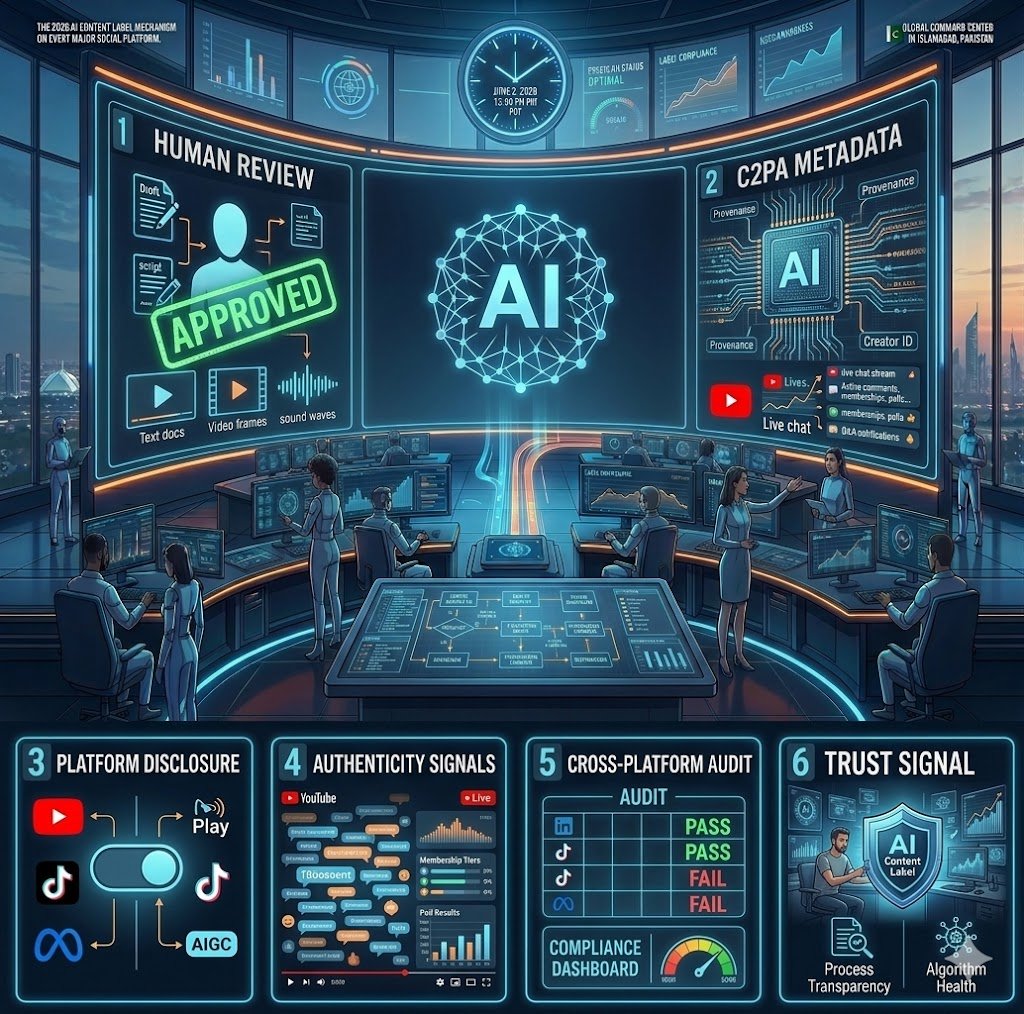
| 1 Adopt the Human Editorial Wrapper Use AI to generate drafts, scripts, or visuals — but always have a human review, edit, and sign off before publishing. Under EU AI Act Article 50, this editorial responsibility exempts you from mandatory labeling, while still capturing AI’s efficiency benefits. |
| 2 Embed C2PA Metadata Proactively Use tools that support C2PA Content Credentials to embed machine-readable provenance data in every piece of AI-assisted content. This future-proofs your content against automated platform detection and demonstrates compliance proactively. |
| 3 Use Platform-Native Disclosure Tools First YouTube’s upload disclosure toggle, TikTok’s in-app AIGC tag, and Meta’s “Made with AI” self-declaration are your first line of compliance. Enable them before a platform’s automated system force-labels your content — that feels worse to audiences than self-disclosure. |
| 4 Lead With Authenticity Signals That AI Cannot Fake YouTube’s algorithm now weights community signals — live Q&As, active comment sections, memberships, polls — more heavily. These engagement patterns are extremely hard for AI-only channels to replicate. Invest in them to signal genuine human channel health. |
| 5 Run Monthly Cross-Platform Compliance Audits Policies differ by platform and evolve rapidly. Audit all active campaigns monthly to verify that all AI-generated content carries the required disclosures for each specific platform. What is compliant on LinkedIn may violate TikTok’s stricter rules. |
| 6 Reframe the Label as a Trust Signal Rather than hiding AI use, transparency-forward creators are turning the AI content label into a storytelling element — showing audiences how AI assisted their creative process. This builds trust rather than eroding it, and positions you as a responsible creator in the eyes of both audiences and platform algorithms. |
The Global Reach: AI Content Labels Are Not Just a European Issue
Importantly, the AI content label is not confined to the EU. India’s Ministry of Electronics and Information Technology (MeitY) has proposed mandatory AI labeling rules requiring platforms like OpenAI, Meta, X, and Google to label AI-generated visuals, audio, and video prominently. Under India’s proposed rules, AI-generated image labels must occupy at least 10% of the surface area of an image, and audio labels must cover the first 10% of an audio clip’s duration.
So, Will the AI Content Label Actually Destroy Your Views?
Ultimately, the honest answer is: it depends entirely on your strategy. Here is what the data shows:
If you are running unlabeled AI content at volume churning out AI-generated videos without disclosure then yes, the 2026 enforcement wave will likely devastate your reach. YouTube’s algorithm already penalizes AI slop channels, and platform-level enforcement across Meta and TikTok will accelerate that decline. Additionally, the EU AI Act’s financial penalties add a legal dimension that goes beyond algorithm suppression.
However, if you use AI as a creative tool with a human editorial layer, proactively disclose where required, and invest in authentic community signals, the data suggests the AI content label will have minimal negative impact on your reach and may even boost trust with a disclosure-conscious audience. In fact, 84% of creators already integrate AI into their workflows according to Epidemic Sound’s 2025 survey, which means AI use is normal. Hiding it is now the abnormal choice.
| “Companies must integrate transparency into their content creation processes, not as a formal requirement but as a commitment to ethics and responsibility.” Juan Carlos Guerrero, Partner TMT: IT/IP, ECIJA |
Frequently Asked Questions About the 2026 AI Content Label
1.What exactly is an AI content label and who needs one?
An AI content label is a visible or machine-readable disclosure marker on content substantially created or modified by artificial intelligence. Under the EU AI Act (Article 50), any individual or company from solo creators to global brands who publishes AI-generated content professionally must apply a label starting August 2, 2026, unless a human has reviewed and taken editorial responsibility for the content
2. Will adding an AI content label hurt my YouTube or TikTok views?
Not necessarily. Properly labeled AI content can still be monetized and recommended on both YouTube and TikTok. What genuinely hurts views is unlabeled AI content detected by platform systems, which triggers forced labels, reduced distribution, or demonetization. Proactive disclosure, combined with authentic community engagement signals, protects your channel health under 2026 algorithm updates.
3. Does the AI content label apply to all social media platforms globally?
The EU AI Act applies to any content directed at users within the EU, regardless of where the creator is based. Additionally, India, California, and other regions have introduced parallel disclosure frameworks. In practice, any creator with a global audience should treat EU-standard compliance as the international baseline, since it is the most comprehensive framework currently in force
4. What is the best AI content label strategy for content creators in 2026?
The most effective strategy combines three elements: (1) a human editorial layer always have a person review and take responsibility for AI-assisted content; (2) platform-native disclosure tools use each platform’s built-in AI label toggle proactively rather than waiting for automated detection; and (3) authenticity signals invest in live interaction, community engagement, and human presence that AI-only accounts cannot replicate at scale
5. s there an exception to the mandatory AI content label rule?
Yes. The EU AI Act’s Article 50 includes a clear exemption: if AI-generated content is reviewed and approved by a human who takes editorial responsibility for it before publication, no mandatory AI label is required. This exception is the foundation of the “human editorial wrapper” strategy that compliance-savvy creators are already using in 2026.
6. How does TikTok’s AI content label system differ from YouTube and Meta?
TikTok uses automated detection through C2PA Content Credentials and proprietary AI models, shifting the compliance burden from creator to platform. Unlike Meta (which relies primarily on self-declaration) or YouTube (which requires manual upload disclosure), TikTok will auto-label or remove undisclosed AI content without waiting for creator action. This makes TikTok the most automated and least forgiving platform for non-compliance in 2026.
7. Can AI-generated content still be monetized with an AI content label?
Yes, on all major platforms YouTube, TikTok, Meta, and LinkedIn properly disclosed AI-generated content remains eligible for monetization. The risk to revenue comes from failing to label: unlabeled AI content detected by platform systems can face ad revenue restriction, demonetization, or Partner Program suspension. The label itself is not a monetization barrier; it is a compliance requirement.
References
01. House of Commons Library “AI Content Labelling” UK Parliamentary Research Briefing, CBP-10467 · May 2026 https://commonslibrary.parliament.uk/research-briefings/cbp-10467/
02. Pandectes.io Editorial Team “Labeling AI Generated Content: What the New Rules Require for Compliance” Pandectes.io · March 11, 2026 https://pandectes.io/blog/labeling-ai-generated-content-what-the-new-rules-require/
03. Guerrero, Juan Carlos (ECIJA Law Firm) “Companies Will Be Required to Label AI-Generated Content Starting from August 2026” ECIJA · September 17, 2025 https://www.ecija.com/en/news-and-insights/las-empresas-deberan-etiquetar-los-contenidos-generados-por-ia-a-partir-de-agosto-de-2026/
04. Vera Content Editorial “How to Label AI-Generated Content (and When You Don’t Need To)” Vera Content · March 24, 2026 https://veracontent.com/mix/labeling-ai-generated-content/
05. WeVenture Digital Agency “AI Labeling Requirement Starting in 2026: What You Need to Know” WeVenture.de · May 2026 https://weventure.de/en/blog/ai-labeling
06. AuditSocials Research Team “AI Content Labels 2026: Meta vs Google vs TikTok Rules” AuditSocials.com · April 7, 2026 https://www.auditsocials.com/blog/cross-platform-ai-content-labeling-requirements-2026-meta-google-tiktok-youtube-comparison
07. MEXC / Crypto.News “India Proposes New Rules Requiring Labeling of AI-Generated Content” MEXC News · October 22, 2025 https://www.mexc.com/news/138670
08. Elad, Barry — SQ Magazine “YouTube Statistics 2026: Growth, Engagement, and Monetization” SQ Magazine · January 23, 2026 https://sqmagazine.co.uk/youtube-statistics/
09. Search Engine Journal “YouTube’s AI Slop Problem and How Marketers Can Compete” SearchEngineJournal.com · March 2, 2026 https://www.searchenginejournal.com/youtubes-ai-slop-problem-and-how-marketers-can-compete/567297/
10. OutlierKit Resources “YouTube Algorithm Updates 2026: Every Confirmed Change Explained” OutlierKit.com · May 2026 https://outlierkit.com/resources/youtube-algorithm-updates/
11. eWEEK Staff “AI Conquers YouTube: Nearly 33% of Your Feed Is Now Fake Content” eWEEK.com · December 30, 2025 https://www.eweek.com/news/ai-slop-conquers-youtube-algorithm/
12. Storrito Editorial “TikTok AI Generated Content Policy and Labeling Requirements in 2026” Storrito.com · 2026 https://storrito.com/resources/tiktoks-2026-ai-labeling-rules-and-what-they-signal-for-platform-governance/

Pingback: How to Actually Eliminate Vibe Coding Problems Forever
Pingback: Claude AI Sell Your Data? Here's What Anthropic Says