
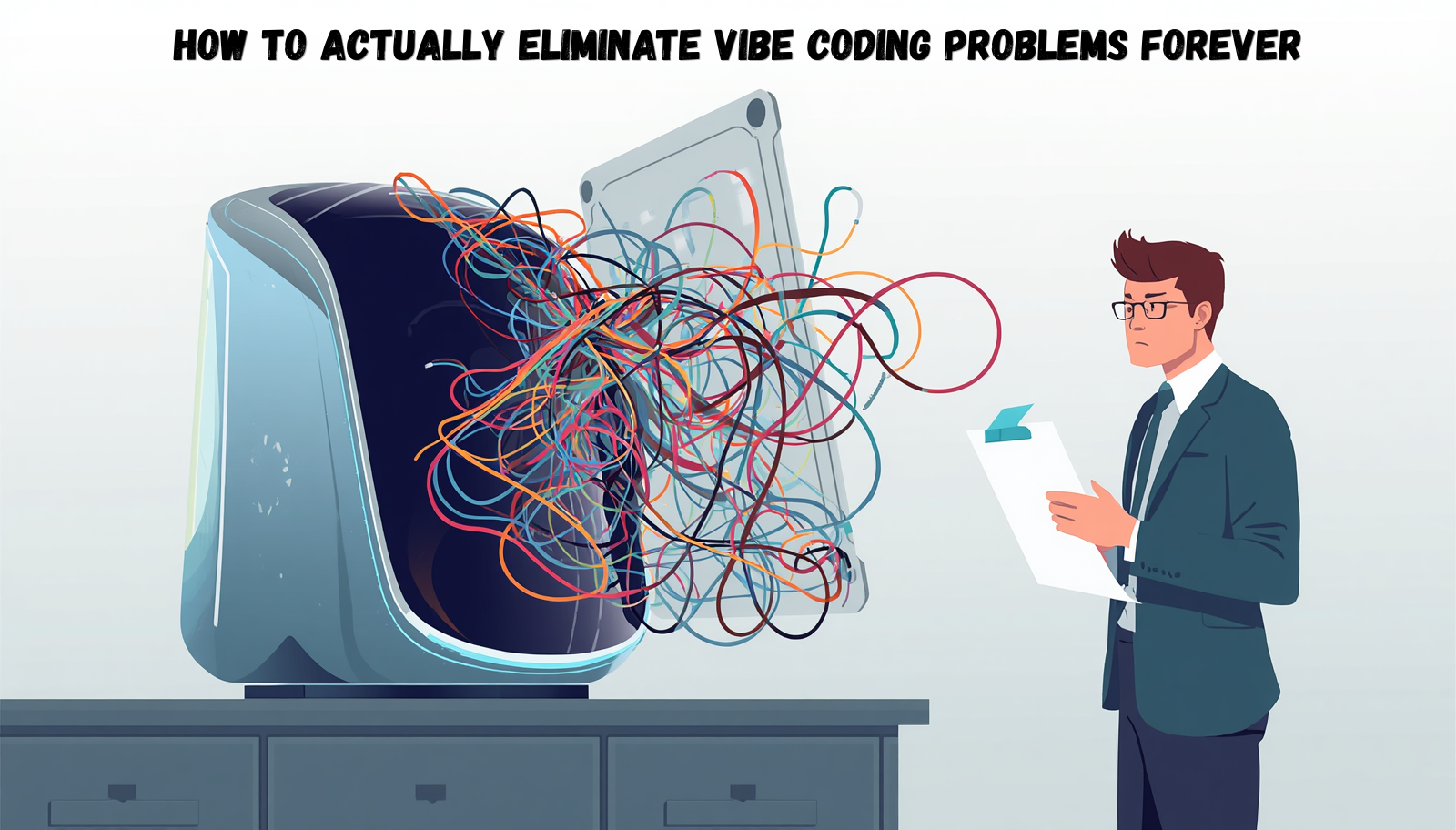
Vibe coding problems went mainstream in 2025 and it broke things fast. The term coined by AI researcher Andrej Karpathy (named Collins Dictionary Word of the Year 2025) has since turned into a $4.7 billion industry, with 90% of developers using at least one AI coding tool at work as of January 2026. The promise? Shipping faster, building more, coding less. The reality? A quiet crisis of insecure apps, bloated codebases, and teams drowning in AI-generated debt.
You don’t need another “AI is amazing” pep talk. You need solutions. So let’s get straight to them.
⚡ The Numbers You Need to See First
- 96% of developers don’t fully trust AI-generated code is functionally correct (Stack Overflow, 2026)
- AI-generated code has 2.74x higher security vulnerability rates than human-written code (CodeRabbit Analysis, 2025)
- 10.3% of Lovable-generated apps had critical security flaws exposing real user data (CVE-2025-48757)
- 63% of vibe coding users are non-developers people who never learned to spot a security hole
- A $1.5 trillion technical debt crisis is quietly building from unreviewed AI code (LinkedIn Expert Analysis, 2026)
Problem #1: How Blindly Accepting Code Creates Vibe Coding Problems
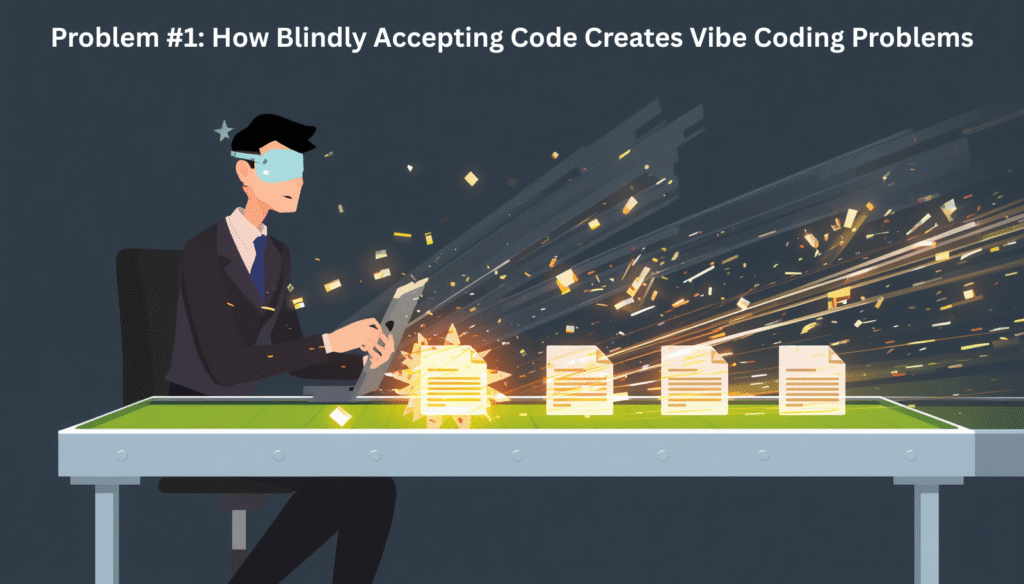
The single biggest vibe coding problem isn’t the AI. It’s the workflow of clicking “Accept All” without review. A Stanford RCT study found developers using AI tools wrote less secure code than those who didn’t — while simultaneously reporting higher confidence in security. That overconfidence is the trap.
✅ The Fix: Adopt the Supervisor Mindset
Stop treating AI as a senior developer. Treat it as a fast junior who needs review. Every single output. Here’s the exact process:
- Run tests immediately after every accepted output don’t batch them
- Run type checks (pnpm typecheck), full test suite, and lint before moving on
- If any fail stop. Use /rewind or fix before the next prompt
- Never go more than 20–30 minutes between test runs
Problem #2: Your Prompts Are Too Vague And the AI Is Guessing
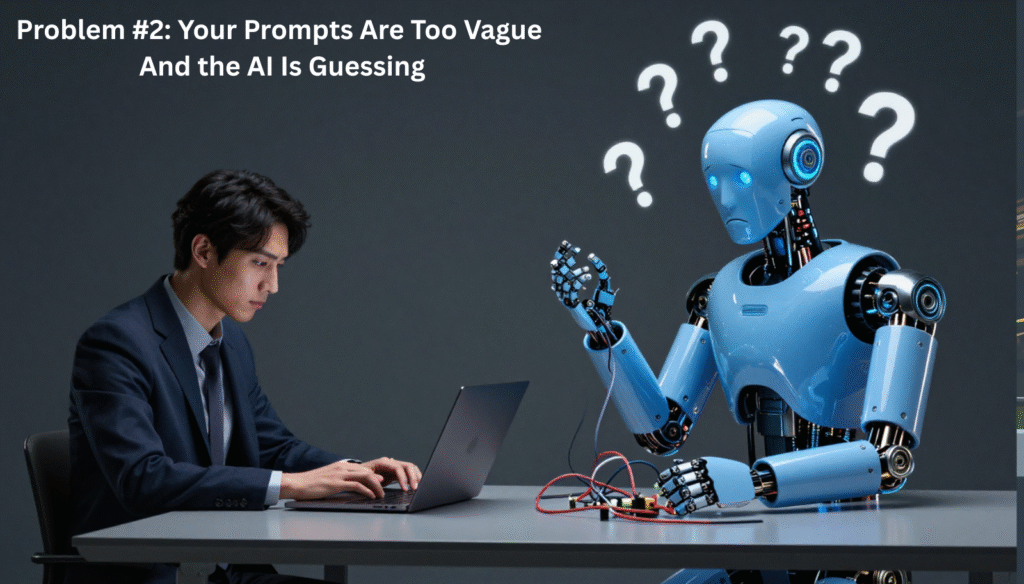
“Build me a login system” is not a prompt it’s a prayer. When you give the AI insufficient context, it fills the gaps with assumptions. Those assumptions become bugs, security holes, and architecture decisions you didn’t sign off on.
✅ The Fix: Spec-Driven Development
The emerging best practice among experienced vibe coders is writing a clear spec before handing off to the AI. Structure every prompt like this:
- Goal: One sentence on what this feature accomplishes
- Architecture: What components exist, how they communicate, what the data model looks like
- Constraints: Frameworks, size limits, existing patterns to follow
- Edge cases: What must NOT happen
Problem #3: Security Vulnerabilities Hidden in Plain Sight (The Most Dangerous Vibe Coding Problems)

This is the most dangerous vibe coding problem because you can’t see it. The Lovable CVE-2025-48757 incident was a wake-up call: 170 apps handling real user data had critical row-level security flaws. A 2026 security audit revealed 45% of AI-generated code contains high-risk security flaws. AI-generated Java code? A staggering 72% security failure rate.
Vibe coding tools optimize for speed of creation not security by default.
✅ The Fix: Automated Security Scanning + Review Gates
- Add automated vulnerability scanning to every build not just before production releases
- Specifically test user authentication, input validation, and access control in every AI-generated auth feature
- Never deploy AI-generated code that touches user data without an experienced developer reviewing the access control logic
- Keep exposed API keys on a checklist check every single deployment
Problem #4: Technical Debt That Compounds Daily
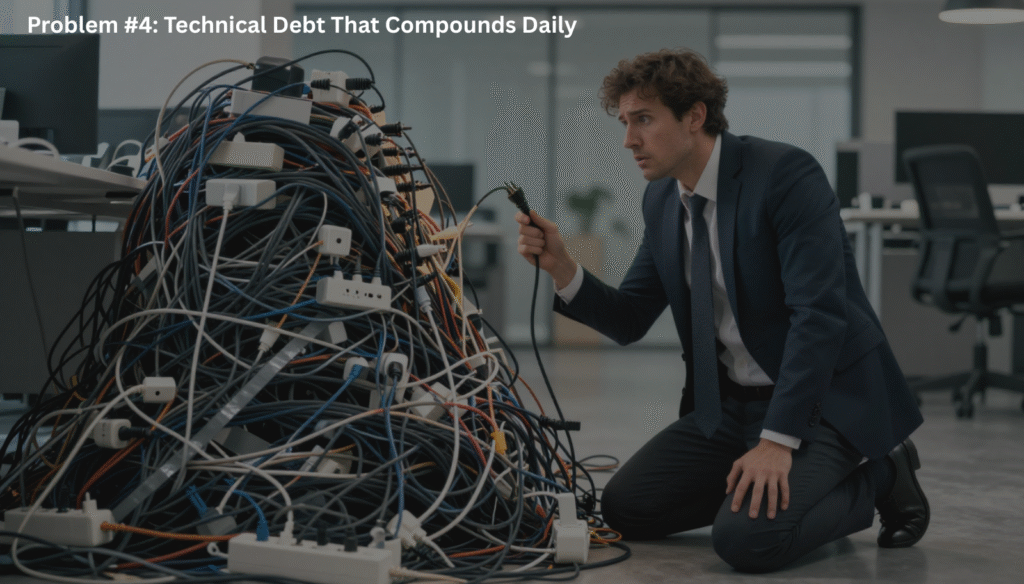
AI generates code fast. That’s the appeal. But fast code without architecture thinking accumulates into an unreadable, unmaintainable mess. Warning signs you’re already there:
- Response times degrading as usage grows (inefficient AI-generated algorithms)
- Teams building “creative workarounds” instead of fixing the root issue
- New developers can’t understand the codebase structure
- Debugging takes longer than rebuilding from scratch
✅ The Fix: Evolution-Focused Thinking + Documentation Discipline
Treat AI output as validation that your product should work as intended not as a finished product. Document every session: which code was AI-generated, what prompts were used, what manual changes were made. This supports debugging, regulatory compliance, and team onboarding.
Problem #5: When Hallucinated Packages Cause Vibe Coding Problems in Production
This one blindsides people. In a sample of 2.2 million code samples, over 440,000 referenced hallucinated (non-existent) packages. Your app looks fine in development. Then it breaks on deployment because the AI invented a library that doesn’t exist.
✅ The Fix: Package Verification Protocol
- Every time AI suggests a package or library, verify it exists on npm/PyPI before accepting
- Prefer widely-used, familiar frameworks where AI output is better trained and more reliable
- Lock your package versions and run a full install on a clean environment before any major deployment
- Treat import errors in AI code as red flags not as minor issues to skip past
Problem #6: The Testing Gap Nobody Talks About
The ICSE 2026 systematic review of 101 sources on AI-assisted coding quality found one thing almost universally true: QA is the most consistently skipped dimension of vibe coding workflows. Not because developers don’t care. Because no standard checklist exists.
✅ The Fix: The 4-Phase Vibe Coding Testing Checklist
- BEFORE generation: Define expected inputs, outputs, and edge cases in your prompt
- AFTER generation: Run type checks, unit tests, and lint. Don’t continue if any fail
- BEFORE deployment: Full integration test, security scan, check all authentication paths
- AFTER deployment: Monitor error rates, check edge cases real users find within 48 hours
The Productivity Reality: Looking Past the Vibe Coding Problems
Here’s what the data actually says about productivity when vibe coding problems are done right:
- API integration, boilerplate, and CRUD: up to 81% time savings
- Overall productivity improvement: 26% (McKinsey, Feb 2026 across 150 enterprises)
- Complex architecture and novel algorithm work: can slow you down by 19%
- Time on routine coding tasks reduced by 46% (McKinsey, 2026)
The conclusion: vibe coding is powerful for the right tasks. The developers winning with it are the ones who know the difference.
Related reading: 2026 AI Content Label Rules — What You Need to Know Before You Publish
The Bottom Line: Vibe Coding Problems Works When You Work It Right
The vibe coding problems plaguing most developers in 2026 are not AI problems. They’re process problems. The AI does exactly what you tell it vaguely, quickly, without asking questions. The developers eliminating these problems permanently are the ones who bring architecture thinking, spec discipline, and testing rigor to an AI-first workflow.
Use the AI for speed. Keep the human for judgment. That combination is what separates working prototypes from production systems that hold.
Frequently Asked Questions
Q1: What exactly are vibe coding problems?
Vibe coding problems are the specific failure modes that emerge when developers or non-developers accept AI-generated code without adequate review, testing, or security scanning. The term ‘vibe coding’ was coined by Andrej Karpathy in February 2025 to describe building software by describing what you want in natural language and accepting AI output with minimal review. The problems are not caused by the AI being broken they are caused by deploying AI output as if it were pre-reviewed production code. The six most common problems are: over-trusting AI output, vague prompts that produce insecure defaults, hardcoded credentials, repeated vulnerability classes across projects, hallucinated packages, and skipped testing phases.
What is spec-driven development and why does it fix vibe coding problems?
Spec-driven development means writing a structured feature specification before prompting the AI covering the goal, architecture, constraints, and edge cases in a single prompt. It directly addresses the root cause of most vibe coding security problems: AI models trained on older codebases filling prompt gaps with insecure defaults. Georgetown CSET found XSS vulnerabilities in 86% of AI-generated samples produced by standard developer requests not malicious ones. Spec-driven prompts replace open-ended requests with constrained ones, dramatically reducing the probability that the AI defaults to a string-concatenated SQL query, an unauthenticated endpoint, or an unvalidated input. The CLAUDE.md or .cursorrules file extends this to every session by giving the AI your project’s security standards as persistent context.
What is the CLAUDE.md file and how does it reduce vibe coding problems?
CLAUDE.md (or .cursorrules for Cursor users) is a persistent context file placed in your project root. It tells the AI your tech stack, coding conventions, security requirements, and hard boundaries that apply to every prompt in the project — without you having to repeat them session by session. In practice, it reduces vibe coding problems in two ways: it stops the AI from defaulting to insecure patterns from its training data by explicitly specifying your security standards, and it enforces consistency so that AI-generated code matches your existing architecture instead of inventing its own. For teams, it functions as a living AI style guide that scales your engineering standards across everyone using AI tools on the same codebase.
References
1. Stack Overflow Developer Survey 2026 — Developer Trust in AI Tools
2. Taskade — State of Vibe Coding 2026: Market Size, Adoption & Trends
https://www.taskade.com/blog/state-of-vibe-coding-2026
3. 13Labs — Vibe Coding Statistics 2026: 84 Data Points
https://www.13labs.au/guides/vibe-coding-statistics-2026
4. Kristian Larsen — Vibecoding Statistics: 2026 Data and Trends
https://www.kristian-larsen.com/info/vibecoding-statistics
5. We Are Notch — Vibe Coding Best Practices (April 2026)
6. Roadmap.sh — Vibe Coding Best Practices: How To Get Consistent Results
https://roadmap.sh/vibe-coding/best-practices
7. Getautonoma — Vibe Coding Best Practices: The Testing Checklist You’re Skipping (ICSE 2026)
https://getautonoma.com/blog/vibe-coding-best-practices
8. Expert LinkedIn — Vibe Coding Has Won. Now Comes the Hard Part (March 2026)
https://expertlinked.in/posts/2026-03-10-vibe-coding-won-hard-part
9. Sid Bharath — What is Vibe Coding? The Complete Guide (2026)
https://sidbharath.com/blog/vibe-coding-guide
