
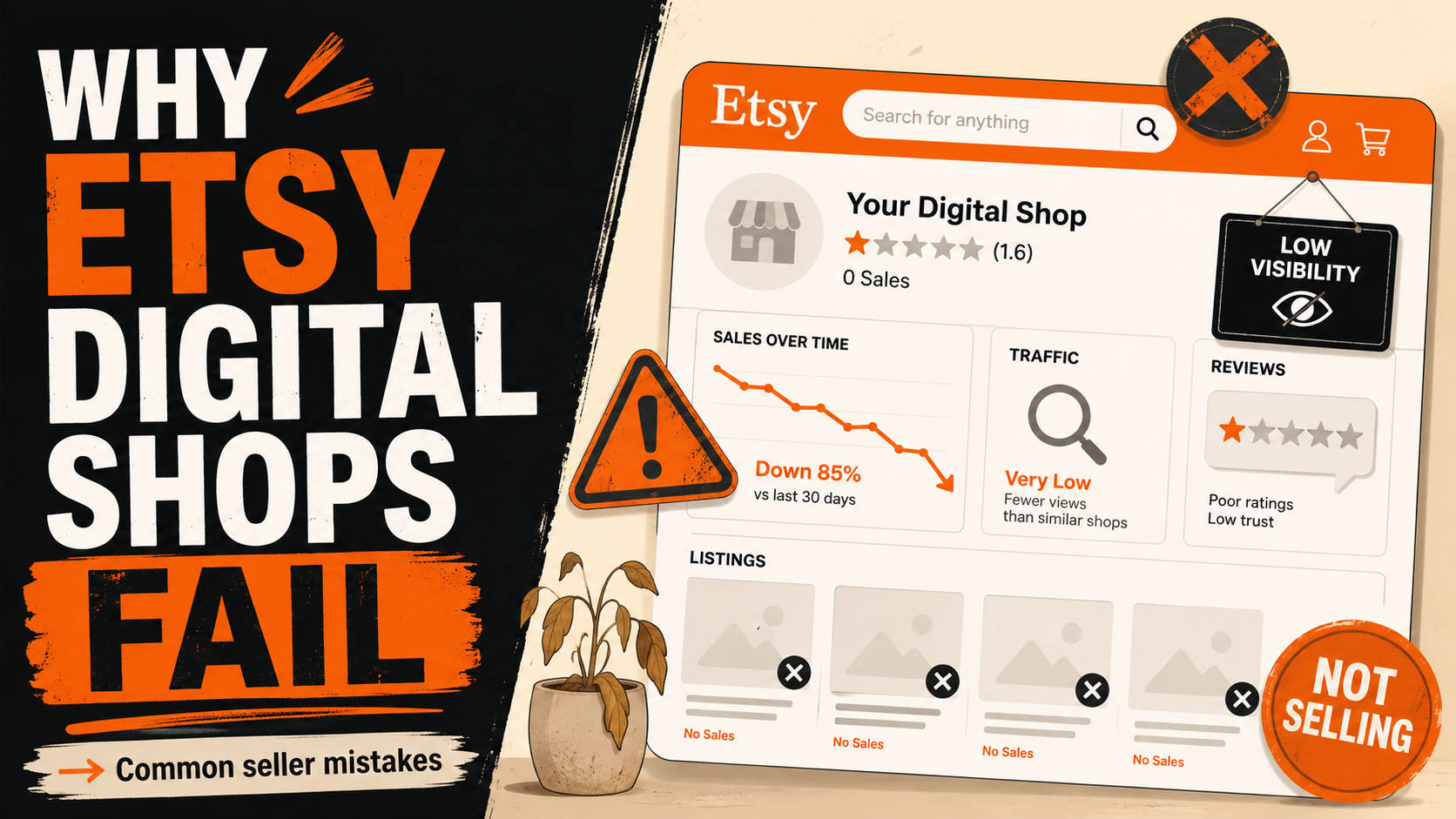
Etsy Digital Shops are opening faster than ever in 2026, but most of them quietly close within a year. In fact, according to recent Etsy marketplace data, the platform now hosts more than 7.5 million active sellers and over 140 million listings, yet fewer than 500,000 sellers ever cross $10,000 in annual sales. So, why do so many new shops fail while a small group thrives?
Opening a shop feels easy at first. You upload a file. You write a title. Then, you wait for sales. Unfortunately, the sales often don’t come.
This is the story for most new digital sellers. Nine out of ten close within the first year. However, a small group breaks through and builds real, steady income from digital downloads. So, what do they do differently?
This guide breaks down the top mistakes that sink new Etsy Digital Shops in 2026. Then, it walks through the exact steps that move you into the winning 10%.
The Real Reason Etsy Digital Shops Fail
Most sellers blame “the algorithm” first. In reality, that’s rarely the true cause.
Instead, the real problem is much simpler. New sellers treat their shop like a hobby, while successful sellers treat it like a real business. Because of this single shift, everything else changes from product research to pricing to consistency.
Additionally, the digital products category is now Etsy’s fastest-growing segment, with roughly 25% year-over-year growth. As a result, competition has increased sharply. Therefore, sellers who still rely on outdated, low-effort tactics get buried fast.
Let’s look closely at the specific mistakes behind most failed Etsy Digital Shops.
Top Mistakes Behind Failing Etsy Digital Shops

1. Weak or Copied Product Ideas
Many new shops sell the exact same planner or template as thousands of other sellers. Consequently, buyers can’t tell one shop from another, and nothing stands out. As a result, nothing sells.
Fix: Instead, pick a narrow niche. For example, a “wedding budget planner for destination weddings” beats a generic “budget planner” almost every time, since it speaks directly to one clear buyer.
2. Poor Listing Titles and Tags
First and foremost, Etsy functions as a search engine. So, if your title doesn’t match what buyers actually type, they will never find your shop at all. Vague titles like “Cute Planner,” for instance, waste valuable search space.
Fix: Use clear, keyword-rich titles instead. Furthermore, study what buyers really search for, then match your title and all 13 tags to that exact language.
3. No Real Product Photos
Since buyers can’t touch a digital file, your images become the only thing actually selling the product. Meanwhile, blurry mockups or a single flat preview image quietly kill conversions.
Fix: Show the product in real use whenever possible. Also, add lifestyle mockups, and, if you can, include a short video or GIF to build extra trust.
4. Ignoring Reviews and Trust Signals
Naturally, new shops start with zero reviews. Because of this, buyers often hesitate to trust an unknown seller with their money, and many sellers give up right at this exact point.
Fix: To begin with, price your first few listings slightly lower. Then, ask happy buyers for reviews. Once real feedback appears, trust tends to build quickly.
5. Giving Up Too Early
Generally, Etsy SEO takes real time to build momentum. Still, many sellers quit after just 30 days with zero sales — often right before the algorithm starts favoring their shop.
Fix: Instead, commit to at least 90 days. Meanwhile, keep adding new listings weekly, since consistency beats a single “perfect” listing every time.
What Successful Etsy Digital Shops Do Differently in 2026

Now that the mistakes are clear, let’s look at what actually works. Here’s the shift that separates thriving Etsy Digital Shops from failed ones.
- Research before you create. First, use Etsy’s own search bar, along with tools like eRank, to confirm real demand before designing a product.
- Build a small catalog, not one listing. Shops with 20 or more related listings consistently outsell shops with only two or three, since more listings mean more chances to be discovered.
- Write for humans first, keywords second. Clear, honest listings ultimately convert better than keyword-stuffed ones, even though keywords still matter for visibility.
- Track your numbers weekly. Specifically, watch views, favorites, and conversion rate, then adjust quickly whenever something isn’t working.
- Understand your margins. Because digital products carry no shipping cost, sellers typically keep 70% to 85% of revenue after Etsy’s $0.20 listing fee, 6.5% transaction fee, and payment processing costs. Therefore, even modest sales volume can add up fast.
- Study fast-moving niches early. Markets can shift quickly, much like emerging tech markets grow fast when demand spikes. Similarly, Etsy trends move in waves, so sellers who spot a rising niche early often capture the most sales before it gets crowded.
Why 2026 Is Actually a Good Time to Start
Interestingly, despite rising competition, 2026 still offers real opportunity for new Etsy Digital Shops. Etsy’s gross merchandise sales now sit above $13 billion annually, and digital downloads remain one of the few categories still growing at double-digit rates. Moreover, international buyers now account for nearly half of all marketplace sales, which means demand keeps expanding well beyond the U.S.
At the same time, buyer expectations have changed. Shoppers no longer want random, generic downloads. Instead, they want clarity, simplicity, and products that genuinely solve a problem or save time. Consequently, sellers who focus on outcomes, not just aesthetics, tend to see stronger reviews and faster visibility.
FAQ: Etsy Digital Shops in 2026
Why do most Etsy Digital Shops fail in the first year?
Most shops fail because of weak niche selection, poor titles and tags, thin trust signals, and giving up before Etsy’s SEO has time to build momentum, usually around the 90-day mark.
How much can a new Etsy Digital Shop realistically earn?
Earnings vary widely. Many sellers earn under $500 a year, while the top 1% account for a large share of total marketplace sales. However, sellers who build a catalog of 20+ optimized listings and stay consistent tend to see steady, compounding growth.
Are digital downloads still profitable on Etsy in 2026?
Yes. Digital products remain one of Etsy’s fastest-growing categories, and since there’s no shipping cost, sellers typically keep 70% to 85% of revenue after fees.
Q: How long does it take for a new Etsy Digital Shop to start selling?
Most successful sellers see momentum build within 60 to 90 days, provided they publish consistently and optimize titles, tags, and images from the start.
Q: What’s the biggest mistake new Etsy Digital Shop owners make?
Quitting too early. Many sellers stop posting new listings right before the algorithm starts favoring their shop, resetting the progress they’ve already made.
Final Thoughts
Ultimately, most Etsy Digital Shops fail for entirely avoidable reasons: weak niches, poor titles, thin trust, and early quitting. Fortunately, fixing these five mistakes already puts you ahead of most sellers on the platform.
In the end, Etsy rewards sellers who treat their shop like a real, ongoing business rather than a side experiment. So, start small, stay consistent, and track your progress closely. Over time, your shop can move steadily into that winning top 10%.
If you’d like to see these principles in action, check out Color Uncover on Etsy for real examples of optimized digital listings.

Pingback: 7 Etsy SEO Mistakes: Proven Fixes to Protect Your Sales