

Today, defense tech market growth is changing how Silicon Valley investors spend their money. In fact, top venture capital firms are moving away from simple consumer apps. Instead, investors are pouring billions into military artificial intelligence, autonomous drones, and defense software. As a result, national security has become one of the fastest-growing sectors in the technology world.
What Is Behind the 2026 Defense Tech Market Growth?
In 2026, defense technology is no longer a small or quiet industry. Instead, it is now a main driver of global tech innovation.
Specifically, three key forces are powering this rapid expansion:
- Record Venture Funding: Investors put over $19.8 billion into defense startups during Q1 2026. You can track these real-time deal numbers on market sites like PitchBook.
- Focus on Smart Software: Modern defense depends on fast data, cloud networks, and autonomous software. Therefore, software is replacing traditional heavy hardware.
- Urgent Government Demand: Military groups want flexible code updates from agile startups. As a result, small tech teams are winning huge government deals.
| 2026 Market Metric | Value / Statistic | Primary Impact on Tech |
| Q1 2026 (Global Venture Capital) Funding | $19.8 Billion | Sets an all-time quarterly record for defense startups |
| Average Series B Deal Size | $85 Million | Proves that defense startups can scale up quickly |
| Autonomous Software Share | 58% of Capital | Shows that software creates the most value in defense |
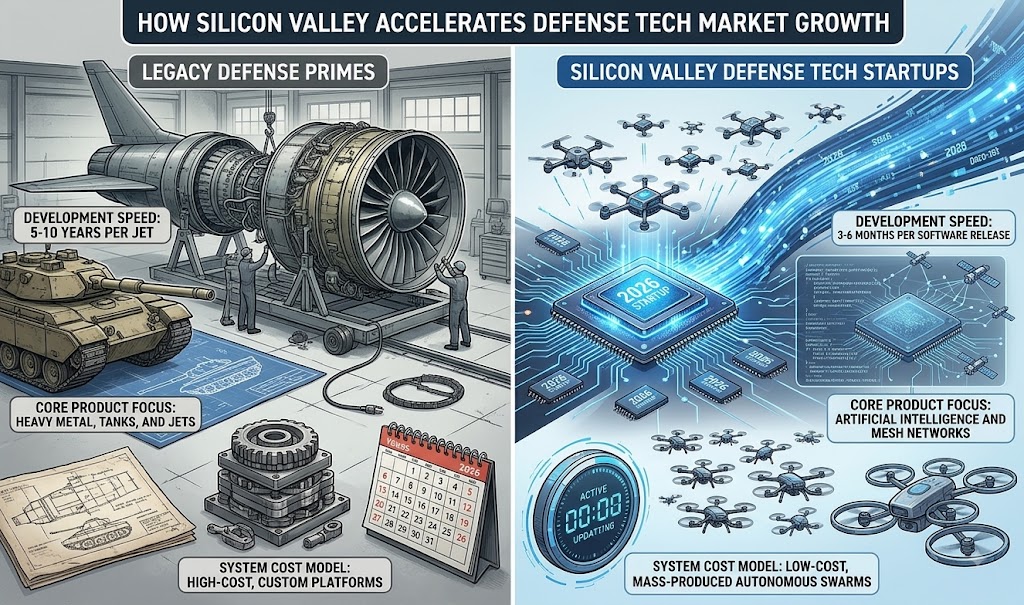
In the past, venture capital funds avoided military tech startups. They worried about slow government sales cycles and strict trade laws. However, private capital now moves much faster than before.
For example, agile engineering teams can build and test software in weeks. Consequently, top venture capital firms are backing startups to challenge old defense suppliers.
| Feature / Metric | Legacy Defense Primes | 2026 Defense Tech Startups |
| Development Speed | 5 to 10 years per jet | 3 to 6 months per software release |
| Core Product Focus | Heavy metal, tanks, and jets | Artificial intelligence and mesh networks |
| System Cost Model | High-cost, custom platforms | Low-cost, mass-produced autonomous swarms |
Key Companies Driving Defense Tech Market Growth
Several standout companies are leading this revolution in 2026:
- Anduril Industries: Raised $5 billion in early 2026, which pushed its private valuation to $30.5 billion.
- Shield AI: Builds self-flying AI software that works smoothly without GPS signals.
- Saronic: Builds autonomous boats for sea missions, securing over $1.75 billion in fresh funding.
- Palantir Technologies: Continues to win multi-year contracts for battlefield data, as reported by Bloomberg Tech.
Dual-Use Tech: Powering Defense Tech Market Growth
Furthermore, one major key to sustained defense tech market growth is the rise of dual-use technology. In simple terms, dual-use tools are built for national security, but they also solve big problems in civil industries.
For instance, rugged sensors built for military drones work very well in civil factories. Similarly, software created for battlefield surveillance can improve modern farming.
A great example is how rugged sensor networks power modern edge computing in agriculture to help farmers track crop health automatically.
Key Takeaway: Dual-use technology lowers financial risk for investors. If a military deal is delayed, the startup can still sell its products to commercial farms, energy plants, and logistics firms.
In addition, you can learn how government programs back dual-use projects on the official U.S. Defense Innovation Unit (DIU) website.
Key Challenges to Defense Tech Market Growth in 2026
Despite strong gains, defense tech founders still face tough challenges:
- Slow Government Approvals: First, moving from a short test project to a long-term contract can take over a year.
- Capital Concentration: In addition, over 60% of funding goes to the top four defense unicorns. Therefore, smaller early startups must work harder to raise money.
- Strict Trade Regulations: Finally, hardware and software companies must follow strict international export rules.
FAQ
1. Why is defense tech market growth accelerating so quickly in 2026?
Global tension, fast AI progress, and low-cost autonomous hardware have pushed governments to buy agile software. Therefore, venture capital funds are backing defense startups at record levels.
2. What is dual-use technology in defense tech?
Dual-use technology refers to software or hardware made for defense that also works in civil commercial markets. Examples include autonomous navigation, smart computer vision, mesh communication networks, and agricultural sensors.
3. How big is the defense tech venture funding market in 2026?
Global venture funding for defense tech reached $19.8 billion in the first quarter of 2026 alone. Consequently, defense tech is now one of the fastest-growing categories in modern technology investing.
Summary:
Overall, Silicon Valley’s shift into defense is not a short-term trend. Instead, it marks a permanent change in how global technology companies scale up. As software, robotics, and artificial intelligence become vital to national safety, defense tech market growth will continue to drive tech sector innovation for many years to come.

Pingback: Why 90% of New Etsy Digital Shops Fail ( How to Be in 10%)