

The Silent Threat Destroying Cotton Crops Worldwide:
Whiteflies on cotton are no longer just a seasonal nuisance; they have become one of the most destructive pest crises in modern agriculture. Tiny, winged, and deceptively fragile-looking, the silverleaf whitefly (Bemisia tabaci) “silently causes billions of losses every year across Asia, Africa, and the Americas.
Cotton feeds the world’s textile industry. In 2025–2026,industry experts estimate global cotton production at nearly 117 million bales, with China, India, Brazil, and the United States accounting for 74% of total output. However, these numbers hide a growing alarm. Whiteflies are spreading faster than ever since they are building resistance to common pesticides and transmitting deadly viruses that no spray can fix.
If you are a farmer, agronomist, or anyone tied to the cotton supply chain, this guide is for you. Here are 7 proven ways to control whiteflies on cotton, backed by the latest research and field-validated results from 2024–2026.
From backyard gardens to large cotton farms, protecting what you grow is everything, a principle at the heart of our 12 Survival Skills in 2026.
Where Are Whiteflies on Cotton Hitting Hardest?
The whitefly crisis is truly global, but some regions are bearing the heaviest burden:
- United States: California’s San Joaquin Valley faces recurring whitefly pressure in cotton, with the silverleaf whitefly (Bemisia argentifolii) being the dominant species.
- Brazil: Field trials from 2024–2025 have confirmed rising whitefly pressure, particularly in the Mato Grosso region
- Africa and South Asia: Agronomists describe Cotton Leaf Curl Disease, transmitted exclusively by whiteflies, as a ‘potential menace’.
- India: In 2015, whiteflies on cotton destroyed two-thirds of Punjab’s cotton crop, leading to farmer suicides. More than 95% of India’s cotton area is under Bt cotton, which offers no protection against sucking pests like whiteflies.
- Pakistan: Cotton contributes 0.8% to Pakistan’s GDP and 60% of its textile exports. Whitefly (Bemisia tabaci) transmitted Cotton Leaf Curl Disease (CLCuD) has caused catastrophic losses in Punjab, and resistance to insecticides is a well-documented crisis.
Whiteflies cause two types of damage. First, they cause direct feeding damage by sucking sap, which leads to yellowing, sooty mold, and sticky cotton. Second, they transmit devastating plant viruses like CLCuD, which destroy yields even when pest numbers are low.
7 Proven Ways to Control Whiteflies on Cotton:
Way 1: Use Resistant or Tolerant Cotton Varieties:

The most sustainable first line of defense against whiteflies on cotton starts before a single seed goes in the ground. Planting whitefly-tolerant or resistant varieties significantly reduces pest pressure and minimizes the need for chemical intervention.
In India, varieties such as Amravathi, Kanchan, Supriya, LK 861, and LPS 141 have demonstrated lower whitefly susceptibility under field conditions. In Pakistan, research published in Plant Molecular Biology Reporter (2025) screened 150 Pakistani cotton genotypes and identified strong genetic variability for whitefly resistance, with high heritability estimates pointing to real potential for breeding programs.
Actionable step: Contact your regional agricultural extension office for locally approved resistant varieties suited to your soil and climate zone.
Way 2: Time Your Sowing to Escape Peak Whitefly Pressure:
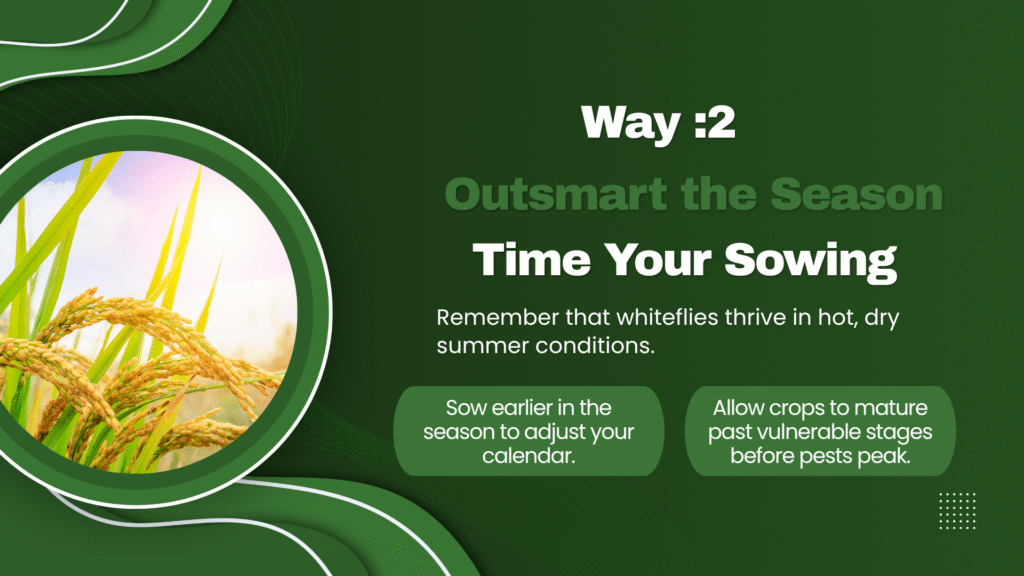
One of the most underrated ways to control whiteflies on cotton is adjusting your sowing calendar. Research consistently shows that late-sown crops face significantly higher whitefly infestation during the critical flowering and boll formation stages. Because whiteflies thrive in hot, dry conditions, their populations explode during the summer months. Therefore, early sowing allows the cotton crop to develop…”
Actionable step: Sow cotton at the recommended date for your region. In Pakistan and North India, this means sowing before late April or early May wherever possible
Way 3: Deploy Biological Control Agents:
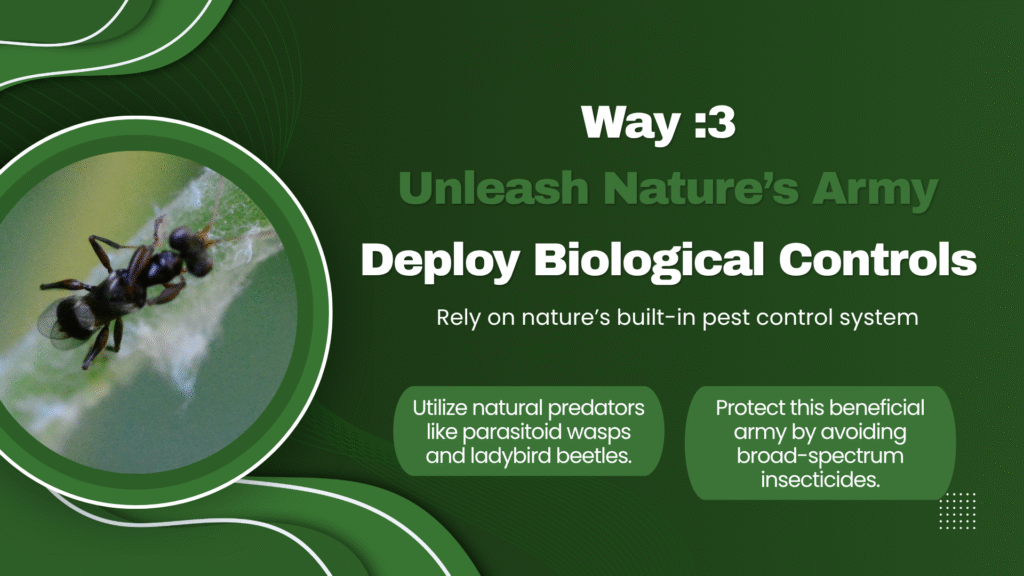
Nature has its own army against whiteflies on cotton, and it works remarkably well when farmers give it a chance. For example, several natural enemies suppress whitefly populations.
- Parasitoid wasps — Encarsia and Eretmocerus species are among the most effective natural enemies. They lay their eggs inside whitefly nymphs, killing the pest from within.
- Predatory insects — Bigeyed bugs (Geocoris punctipes), green lacewing larvae, and ladybird beetles actively prey on whitefly nymphs and eggs.
- Entomopathogenic fungi — A 2022 review in MDPI Agriculture confirmed that fungi like Beauveria bassiana and Isaria fumosorosea are proven, biologically sustainable tools for controlling Bemisia tabaci, and are gaining rapid adoption in integrated pest management (IPM) programs worldwide.
Actionable step: Avoid broad-spectrum insecticides during natural enemy activity periods. Selective pesticides protect the predator population that naturally keeps whitefly numbers in check
Way 4: Install Yellow Sticky Traps for Early Monitoring:
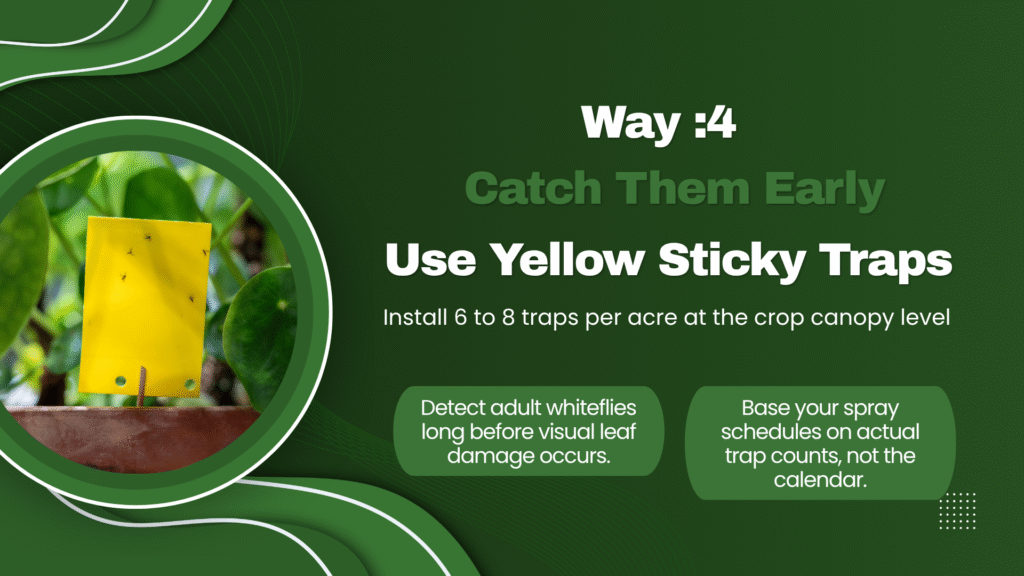
You cannot control what you cannot see. Early detection of whiteflies on cotton is critical — by the time visual symptoms appear on leaves, populations may already be out of hand.
Yellow sticky traps are a simple, cost-effective monitoring tool that catches adult whiteflies before their numbers explode. Research recommends installing 6 to 8 traps per acre, placed at canopy level. Trap counts help farmers make informed spray decisions rather than blanket, calendar-based applications that accelerate resistance.Actionable step: Install yellow sticky traps at crop emergence and check them weekly. Use trap counts to set your action threshold before reaching for a pesticide
Way 5: Apply Targeted, Rotation-Based Chemical Control:

When chemical intervention becomes necessary against whiteflies on cotton, the method and timing matter more than the product. Repeated use of the same insecticide class is the primary driver of resistance. Resistance is already a serious, documented problem in Pakistan, India, and the US.
Proven insecticide classes for whitefly control in cotton include:
- Neonicotinoids: Acetamiprid (Assail) is effective for adult whitefly, especially when populations are migrating in the early season.
- Insect growth regulators (IGRs): Best used on young plants; they disrupt whitefly nymph development.
- Spirotetramat and Flonicamid: Systemic options proven effective in 2025 field trials across Asia.
- Spidoxamat: A 2025 study published in Environmental Science & Technology validated spidoxamat-based control strategies using field trial data from India, Pakistan, and Brazil, finding a second application timed 7–14 days after the first significantly enhanced population control.
Actionable step: Rotate between insecticide classes with different modes of action every spray cycle. Never apply the same chemistry twice in a row.
Way 6: Manage the Field Environment to Reduce Whitefly Habitat:

Whiteflies on cotton don’t live in your crop alone. They overwinter and reproduce on weeds and alternate host plants surrounding your field and then migrate in when conditions favor population growth. Removing this reservoir is a highly effective and often overlooked control method.
Key cultural practices proven to reduce whitefly pressure:
- Remove alternate weed hosts such as Abutilon indicum (Indian mallow) and Solanum nigrum from field edges and neighboring areas.
- Avoid excessive nitrogen fertilization:Lush, succulent plant growth from over-application of nitrogen actively encourages whitefly population buildup.
- Switch to drip or sprinkler irrigation: Research shows that drip and sprinkler systems reduce whitefly density compared to flood irrigation by lowering the warm, humid micro-environment that whitefly populations prefer.
- Practice crop rotation: Rotate cotton with non-preferred host crops such as sorghum, ragi, or maize to break the whitefly cycle.
Actionable step: Walk your field boundaries and remove weed hosts before and during the cotton season. Combine this with balanced, not excessive, fertilizer application.
Way 7: Adopt AI-Powered Monitoring and Precision Spray Technology:

The most exciting frontier in controlling whiteflies on cotton in 2026 is artificial intelligence and precision agriculture. AI is no longer a buzzword in farming it is a working, field-validated tool that is changing how pest management decisions are made.
Here is how AI is being applied to the whitefly problem:
- AI-based image recognition tools deployed on smartphones and drones can now detect early-stage whitefly infestation on the underside of cotton leaves before visible symptoms appear giving farmers a critical 5–7 day head start on intervention.
- Remote sensing platforms use multispectral drone imagery to map whitefly infestation hotspots across an entire field, allowing precision spraying only where needed reducing chemical use by up to 30–40%.
- “Researchers are developing predictive AI models using weather parameter data…” (temperature, humidity, rainfall) to forecast whitefly population peaks, allowing pre-emptive action. A 2025 study published in the Journal of Phytopathology developed regression models using a decade of data (2011–2020) to predict CLCuD progression and whitefly dynamics based on weather patterns in South Asia.
- Individual-Based Modelling (IBM) Cutting-edge research published in Environmental Science & Technology (2025) used AI-driven IBM simulations to optimize insecticide application timing and dosage across varying temperature regimes in India, Pakistan, and Brazil.
Actionable step: Explore AI-based crop monitoring apps available in your region. Many agricultural extension programs in Pakistan, India, and the US now offer drone-based pest scouting services at subsidized rates
Summary Table: 7 Proven Ways at a Glance
| # | Method | Best For | Cost Level |
| 1 | Resistant varieties | Prevention | Low |
| 2 | Early sowing | Prevention | Zero |
| 3 | Biological control | Sustainable long-term | Low–Medium |
| 4 | Yellow sticky traps | Monitoring & early detection | Low |
| 5 | Rotational chemical control | Active infestation | Medium–High |
| 6 | Cultural/field management | Habitat reduction | Low |
| 7 | AI & precision agriculture | Advanced monitoring | Medium–High |
FAQ: Whiteflies on Cotton
What are the first signs of whiteflies on cotton?
The earliest signs are tiny white adults flying up when leaves are disturbed, yellowish spots (chlorosis) on the upper leaf surface, and sticky honeydew residue on leaves. As populations increase, sooty mold (black fungal coating) develops on the sticky honeydew, reducing photosynthesis and making cotton fibers sticky and unmarketable.
Why are whiteflies on cotton so difficult to kill with sprays?
Whiteflies on cotton are notoriously resistant to many common insecticides because they have been exposed to the same chemical classes repeatedly over decades. Nymphs also feed on the underside of leaves, which conventional sprayers often miss. Resistance is well documented in Pakistan, India, and the United States, making rotation of chemical modes of action essential.
Can whiteflies on cotton spread disease to neighboring crops?
Yes. Adult whiteflies are highly mobile and migrate from defoliated cotton fields into neighboring vegetable crops such as tomatoes, cucumbers, and beans, carrying Cotton Leaf Curl Virus (CLCuV) and other plant viruses with them. Even very low whitefly numbers can transmit viruses if those viruses are already present in the field.
Is Bt cotton resistant to whiteflies?
No. Bt cotton is genetically modified to produce toxins that control lepidopteran pests such as bollworm but it offers no resistance to sucking pests like whiteflies. In fact, because Bt cotton reduces the number of broad-spectrum insecticide sprays applied for bollworm, it can indirectly allow whitefly populations to build up faster in the absence of natural enemies killed by those sprays
What is the economic threshold for spraying whiteflies on cotton?
The commonly recommended action threshold is 6–8 adult whiteflies per leaf or 8–10 nymphs per leaf on average across sampled plants. Always check the most recent guidance from your national agricultural research institute, as thresholds can vary by growth stage, region, and cultivar.
How does AI help in managing whiteflies on cotton?
AI tools analyze drone imagery, weather data, and historical pest records to detect infestations early, map their spread across the field, predict population peaks, and recommend the most effective and economical time to spray. This reduces input costs, slows pesticide resistance development, and improves overall crop protection outcomes.
Final Word on Whiteflies on cotton
Whiteflies on cotton will not be defeated by a single spray or a single season’s effort. The farmers and nations winning this battle from Punjab’s cotton belt to California’s San Joaquin Valley are those combining resistant varieties, smart cultural practices, biological control, targeted chemistry, and increasingly, AI-powered precision tools.
The 7 methods above are not theories. They are field-proven, research-backed, and available to you right now. Start with what you can implement this season and build toward a complete integrated pest management system that keeps whiteflies on cotton under control year after year.
References
- Springer Nature – Whitefly Resistance in Pakistani Cotton Genotypes (2025): https://link.springer.com/article/10.1007/s11105-025-01581-7
- ICAR India – IPM Validation in Bt Cotton Against Whitefly: https://epubs.icar.org.in/index.php/IJAgS/article/view/115138
- Straits Research – Top Cotton Producing Countries (2025): https://straitsresearch.com/statistic/top-cotton-producing-countries-globally
- Environmental Science & Technology – Spidoxamat Whitefly Control (2025): https://pubs.acs.org/doi/10.1021/acs.est.5c13117
- Journal of Phytopathology – Weather & Whitefly Prediction Model (2025): https://onlinelibrary.wiley.com/doi/10.1111/jph.70115
- NCBI – Entomopathogenic Fungi for Bemisia tabaci Control: https://www.ncbi.nlm.nih.gov/pmc/articles/PMC7564875/
- Journal of Agricultural Research – Sustainable Whitefly Management Pakistan (2024): https://jaragri.com/jar/index.php/jar/article/download/39/24/105
- UC IPM – Cotton Whitefly Guidelines (USA): https://ipm.ucanr.edu/agriculture/cotton/sweetpotato-whitefly-silverleaf-whitefly/
- Fibre2Fashion – Global Cotton Trade 2025–26: https://www.fibre2fashion.com/resources/10900/global-cotton-trade-story-so-far-in-2025-and-what-to-expect-in-2026

Pingback: Robotics in Healthcare Is Taking Over Medicine
thanks
Pingback: AI Pest Detection: Are You Still Fighting Pests the Slow Way